Berberine Benefits: Research on Blood Sugar, Weight and Safety
By Ayush Goyal, Founder, EX1
What randomised trials report on berberine benefits for fasting glucose, cholesterol and waist size, the doses they used, the side effects, and who should not take it.
Berberine benefits, as reported in research, are metabolic and modest. Meta-analyses of randomised trials report lower fasting glucose in adults with raised blood glucose, small reductions in LDL cholesterol and triglycerides, and a few centimetres off waist circumference, while body weight itself did not change significantly in one analysis.
Berberine has cautions too. Its most common side effects are digestive, it reduced the activity of liver enzymes that break down many common medicines in a two-week study, and NCCIH advises that people who are pregnant or breastfeeding should not use it.
Berberine benefits: what does the research show?
Berberine benefits in research are modest. Meta-analyses of randomised trials link berberine to a small fall in fasting glucose, small reductions in LDL cholesterol and triglycerides, and a few centimetres off waist circumference. Body weight itself did not change significantly in one analysis. The glucose trials mostly used 0.9 to 1.5 g a day for one to three months.
Berberine is best read as a modest metabolic effect, measured mainly in people whose numbers were already raised. So read the "who was studied" column before the result.
| What was measured | What pooled trials reported | Who was studied | Source |
|---|---|---|---|
| Fasting glucose | Fell by about 0.59 mmol/L with berberine alone; the fall was larger alongside glucose-lowering medicines | 50 randomised trials, 4,150 adults with raised blood glucose | Frontiers in Pharmacology, 2024 |
| LDL cholesterol and triglycerides | Small reductions over 4 to 24 weeks | 18 placebo-controlled trials, 1,788 adults with high cholesterol | Drugs, 2023 |
| Waist circumference and BMI | About 2.75 cm and 3.27 cm off the waist, and a small drop in BMI | 10 trials (2020); 12 placebo-controlled trials (2025) | Complementary Therapies in Clinical Practice, 2020; Frontiers in Pharmacology, 2025 |
| Body weight | No significant change | 10 trials | Complementary Therapies in Clinical Practice, 2020 |
| Liver fat | A larger fall (52.7% vs 36.4%) at 1.5 g a day, alongside diet and exercise | One open-label trial, 184 adults | PLoS One, 2015 |
What is berberine, and what is berberine called in Hindi?
Berberine is a compound found in Daruharidra, also called Daruhaldi, an Ayurvedic herb used since ancient times, according to a 2021 review in Current Traditional Medicine. In modern randomised trials, berberine is studied mainly for its effects on fasting glucose, cholesterol and waist size, usually over a few months.
Daruharidra is the Hindi and Ayurvedic name for the herb, and berberine is the compound inside it. On a supplement label, look for berberine named in full, with its milligrams per serving.
What do studies show about berberine for blood sugar?
Meta-analyses of randomised trials report lower fasting glucose with berberine. A 2024 meta-analysis in Frontiers in Pharmacology pooled 50 trials with 4,150 adults with raised blood glucose. Taken alone, berberine was linked to a fall in fasting glucose of about 0.59 mmol/L, a result that only just reached statistical significance. The fall was larger alongside glucose-lowering medicines.
Fasting glucose is the blood glucose level measured after a night without food. On your lab report, it is the sample drawn before the morning chai, and it is the outcome berberine trials report most often.
The 2024 analysis is the largest we reviewed. For berberine alone, its result came in at p = 0.048. The usual cut-off is 0.05, so it passed, but only just.
A second review points the same way. A 2025 meta-analysis in Frontiers in Pharmacology, of 12 trials and 889 people, concluded that berberine improves markers of glucose and lipid metabolism, with a favourable safety profile.
A 2021 meta-analysis of 46 trials in adults with raised blood glucose also reported lower HOMA-IR, a marker of insulin resistance.
The US National Center for Complementary and Integrative Health (NCCIH) is more cautious. It says berberine may have a modest effect on blood glucose in adults with raised blood glucose.
Our read: there is a signal, and it is small. It was measured in people whose glucose was already raised, and many of them were on medicines.
If you take medication for blood sugar, consult your physician before use.
Does berberine help with weight loss?
Berberine's effect on weight is small. Two meta-analyses report modest changes: about 2.75 cm and 3.27 cm off waist circumference, and a small drop in BMI. The 2020 analysis of 10 trials found no significant change in body weight itself. NCCIH says there isn't enough rigorous scientific evidence to determine whether berberine is effective for weight loss.
Waist circumference and body weight are separate measures, and berberine trials moved the first more than the second. The 2020 analysis, in Complementary Therapies in Clinical Practice, found no significant change in body weight. The 2025 analysis, in Frontiers in Pharmacology, pooled 12 placebo-controlled trials, including trials in India. Those trials used 300 to 1,500 mg a day for roughly three to five months.
So the tape moved a little and the scale did not. That is a finding, but a narrow one. For another common weight-management pick, see whether garcinia is safe for weight management.
Berberine for cholesterol and fatty liver: what did trials find?
Berberine was linked to small reductions in LDL cholesterol and triglycerides. A 2023 meta-analysis in Drugs covered 18 placebo-controlled trials and 1,788 adults with high cholesterol, mostly in China and Hong Kong, over 4 to 24 weeks. For fatty liver, the evidence we reviewed is one open-label 16-week trial, run at 1.5 g a day.
LDL cholesterol is the fraction of blood cholesterol reported on a routine lipid test. The fatty-liver evidence is thinner. One open-label 16-week trial, published in PLoS One in 2015, enrolled 184 adults with fatty liver and raised blood sugar. Everyone followed diet and exercise. Adding berberine at 0.5 g three times a day was linked to a larger fall in liver fat: 52.7% against 36.4%. Open-label means participants knew what they were taking. That weakens the result. The 1.5 g daily dose in that trial is above EX1's daily amount.
How to take berberine: dose and timing
Berberine is usually taken in divided doses. Trials split it across the day, for example 300 mg or 500 mg three times daily. The most common daily amount in the glucose trials was 0.9 to 1.5 g, for one to three months. Follow your product's label, and check with your physician first if you take any medicine.
A divided dose means the daily amount is split across meals. EX1 is two capsules a day: one with breakfast, one with dinner, about 12 hours apart, always with food. If breakfast is skipped, the first capsule moves to lunch.
How much berberine did the studies use? (mg per day)
- Most common daily dose in glucose trials900 to 1,500 mg
Frontiers in Pharmacology, 2024
- Range across 12 placebo-controlled trials300 to 1,500 mg
Frontiers in Pharmacology, 2025
- 300 mg three times a day, liver-enzyme study900 mg
European Journal of Clinical Pharmacology, 2012
- 500 mg three times a day, liver-fat trial1,500 mg
PLoS One, 2015
- EX1: two capsules a day1,000 mg
EX1 label
Berberine side effects: what to expect
The most common side effects of berberine are digestive: abdominal pain, constipation, diarrhoea, nausea and vomiting, according to NCCIH. In placebo-controlled trials, digestive side effects were more frequent on berberine (2 to 23 percent of participants) than on placebo (2 to 15 percent), and no serious adverse events were reported.
Berberine's side effects sit mostly in the gut. In a 3-month pilot published in Metabolism in 2008, about a third of participants (34.5%) had passing digestive side effects.
If digestive discomfort does not settle, stop taking berberine and speak to your doctor.
Is berberine safe, and who should not take it?
Berberine has not been linked to liver or kidney harm in short trials. NCCIH advises that people who are pregnant or breastfeeding should not use berberine, and that it should not be given to infants. Berberine also reduced the activity of liver enzymes that break down many common medicines.
Berberine's safety data come from short trials, and they carry clear exceptions. A 16-week trial observed no liver toxicity, and a 3-month pilot observed no liver or kidney damage. Longer-term data are limited.
Medicines are the larger question. In healthy men, berberine at 300 mg three times a day for two weeks reduced the activity of the liver enzymes CYP2D6, CYP2C9 and CYP3A4, which break down many common medicines. That is close to EX1's daily amount, which is why anyone on medication should check with their physician first.
NCCIH advises that people who are pregnant or breastfeeding should not use berberine, and that it should not be given to infants, because it can cause or worsen jaundice in newborns.
EX1's product page lists four cautions of its own:
- Not for use during pregnancy or breastfeeding.
- You take prescription medication or manage a diagnosed condition: check with your physician before adding any supplement.
- Under 18, unless supervised by a paediatrician.
- If you take medication for blood sugar, consult your physician before use.
A supplement complements, never replaces, diet, movement and medical care.
Berberine and chromium, berberine and inositol: what is proven?
No clinical trial has tested berberine together with chromium, or berberine with inositol: as of October 2026, we found no combination trial for either pair. Chromium has a recognised role of its own: it contributes to normal macronutrient metabolism and to the maintenance of normal blood glucose levels. Each ingredient's evidence stands separately.
A combination claim needs a trial of the combination. No clinical trial has tested the exact six-ingredient combination in EX1's blend. Two single-ingredient results printed side by side do not show that a pair works better together.
The botanicals in the blend are traditionally used in Ayurveda for digestion and metabolism. On their own, the research is limited: a Cochrane review (2012) found insufficient evidence for bitter melon, and a 2025 umbrella review in Frontiers in Nutrition found a fasting-glucose signal for cinnamon but rated much of the wider evidence weak, without specifying Ceylon cinnamon. Black pepper extract is included in the formula.
Inositol has its own evidence, covered in our guide to myo-inositol and the 40:1 ratio. No trial we reviewed compared the two.
How EX1 fits
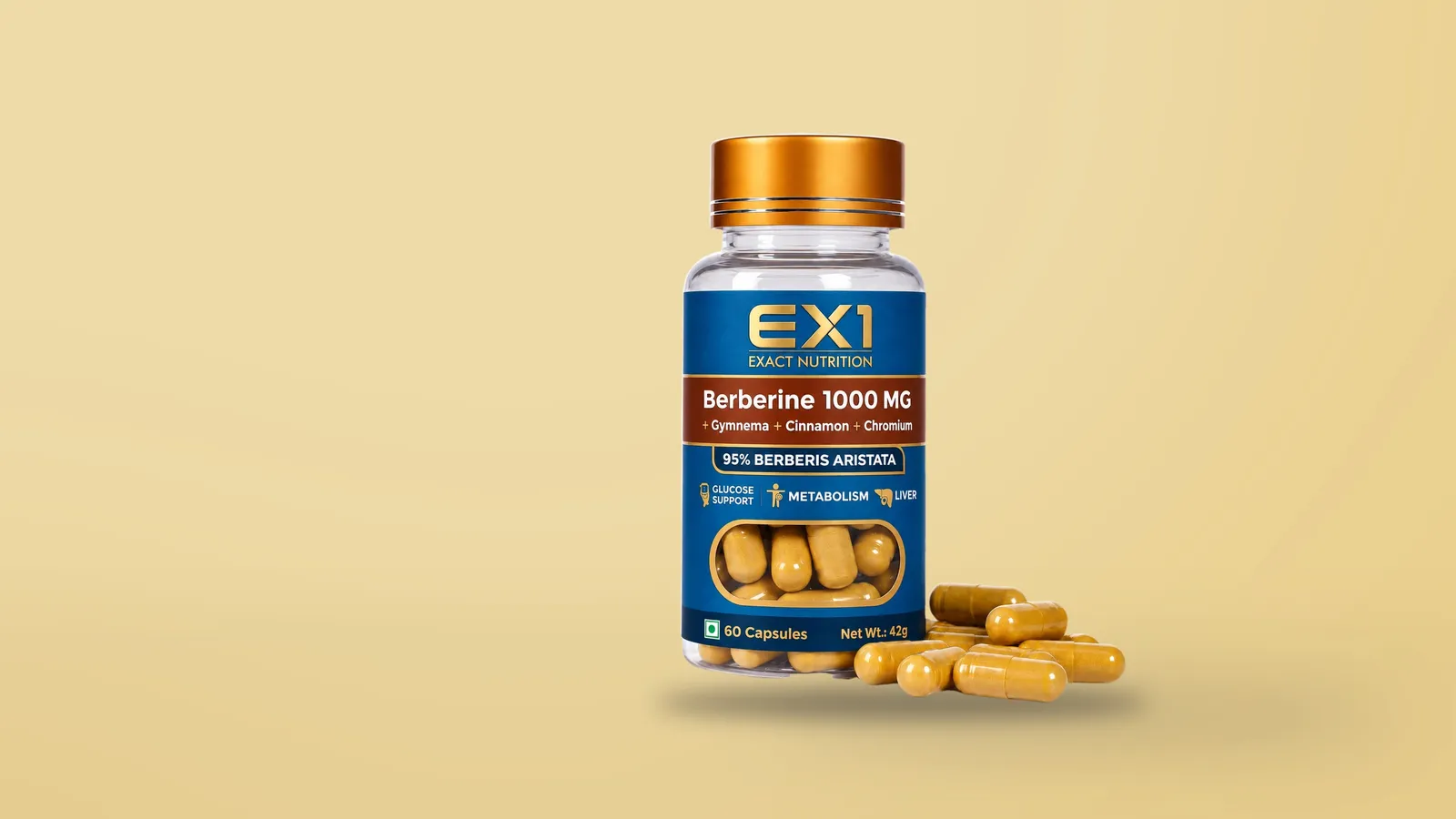
EX1 Berberine is a six-ingredient Ayurvedic metabolism blend: each two-capsule serving gives 1,000 mg of Berberine HCl (95% Berberine), 100 mg each of Gymnema sylvestre, Ceylon cinnamon and bitter melon extracts, 10 mg of black pepper extract (≥95% piperine) and 200 mcg of chromium as picolinate. EX1's 1,000 mg a day sits inside the 0.9 to 1.5 g range most glucose trials used; no trial tested the EX1 blend.
Chromium contributes to normal macronutrient metabolism and to the maintenance of normal blood glucose levels. That is the claim the product makes; the study findings above belong to the studies.
Every milligram is printed on the pack. For how a single combined total on a label can hide each dose, read what a proprietary blend is.
Frequently asked questions
Berberine kab lena chahiye?
Split across the day. Trials usually gave 300 mg or 500 mg three times daily. EX1 is two capsules a day: one with breakfast, one with dinner, about 12 hours apart, always with food. If you skip breakfast, take the first with lunch. If you take medication for blood sugar, consult your physician before use.
How long do berberine studies run?
Most glucose trials in a 2024 Frontiers in Pharmacology meta-analysis lasted one to three months. The 2025 Frontiers in Pharmacology waist and BMI analysis pooled trials of roughly three to five months. The fatty-liver trial in PLoS One ran 16 weeks. Those are study lengths. They do not tell you when you would notice a change.
Is berberine bad for the kidneys or liver?
Short trials have not reported liver or kidney harm. A 16-week trial observed no liver toxicity, and a 3-month pilot observed no liver or kidney damage. Longer-term data are limited, so this covers short use only. Berberine does affect liver enzymes that break down many common medicines, which matters if you take any.
Does berberine suppress appetite?
We found no trial designed to measure appetite. In one 16-week trial, reduced appetite and upset stomach together made up about 31 percent of the berberine-related side effects, all mild. So reduced appetite showed up as a side effect in one trial. Nobody studied it as a benefit, and it is no reason to take berberine.
Does berberine cause constipation or bloating?
Constipation is on NCCIH's list of the most common berberine side effects, with abdominal pain, diarrhoea, nausea and vomiting. The sources we reviewed did not name bloating, so we describe it only as digestive discomfort.
Can I take berberine with inositol or chromium?
No clinical trial has tested berberine with chromium or berberine with inositol; as of October 2026 we found none. If you take prescription medication or manage a diagnosed condition, check with your physician before adding any supplement.
Sources
- Current Traditional Medicine, 2021: review describing Daruharidra (Daruhaldi) as an Ayurvedic herb used since ancient times and a source of berberine.
- Frontiers in Pharmacology, 2024: meta-analysis of 50 randomised trials with 4,150 adults; fasting glucose fell about 0.59 mmol/L with berberine alone; most trials used 0.9 to 1.5 g a day for one to three months.
- Drugs, 2023: meta-analysis of 18 placebo-controlled trials with 1,788 adults with high cholesterol; small reductions in LDL cholesterol and triglycerides; digestive side-effect rates; no serious adverse events.
- Complementary Therapies in Clinical Practice, 2020: meta-analysis of 10 trials; smaller waist circumference and BMI; no significant change in body weight.
- Frontiers in Pharmacology, 2025: meta-analysis of 12 placebo-controlled trials with 889 people, including trials in India; waist circumference, BMI, and glucose and lipid markers.
- PLoS One, 2015: open-label 16-week trial of 184 adults with fatty liver; liver fat at 1.5 g a day with diet and exercise; side-effect profile and liver safety.
- Metabolism, 2008: 3-month pilot; transient digestive side effects in 34.5% of participants; no liver or kidney damage observed.
- European Journal of Clinical Pharmacology, 2012: crossover study in healthy men; berberine reduced CYP2D6, CYP2C9 and CYP3A4 activity.
- NCCIH (US National Center for Complementary and Integrative Health), 2023: berberine evidence summary, common side effects, and pregnancy, breastfeeding and infant guidance.
- Cochrane Database of Systematic Reviews, 2012: insufficient evidence on bitter melon.
- Frontiers in Nutrition, 2025: umbrella review of cinnamon meta-analyses; fasting-glucose signal, with much of the wider evidence rated weak.
- Oxidative Medicine and Cellular Longevity, 2021: meta-analysis of 46 randomised trials; lower HOMA-IR.