Myo-Inositol for PCOS: The 40:1 Ratio, Cycles, Hair and Skin
By Ayush Goyal, Founder, EX1
Trials link myo-inositol to more regular cycles in PCOS, yet the 2023 international guideline sees limited clinical benefit. Here is what the 40:1 ratio means, the doses studied, and where the evidence runs thin.
Myo-inositol for PCOS is linked in trials to more regular menstrual cycles and to some metabolic markers. The 2023 international PCOS guideline still sees limited clinical benefit, and the evidence review behind it called the evidence limited and inconclusive.
The trials exist, and the effects they report are modest. No dose or ratio has guideline backing, 40:1 included. Our read: the cycle data deserves a look, and the guideline's caution is fair.
Myo-inositol for PCOS: what does the 2023 guideline say?
Myo-inositol, like any form of inositol, could be considered for women with PCOS based on personal preferences, says the 2023 international PCOS guideline. The guideline notes limited harm and a possible improvement in metabolic measures, but limited clinical benefit, including for ovulation, excess hair growth or weight. No specific type, dose or ratio is recommended.
The 2023 International Evidence-based PCOS Guideline is the current international guideline on PCOS. On inositol it is cautious: limited harm, a possible metabolic improvement, limited clinical benefit.
That advice leans on a systematic review in the Journal of Clinical Endocrinology and Metabolism, published in 2024. The review covered 30 trials and 2,230 women. It found evidence suggesting benefit for myo-inositol or D-chiro-inositol on some metabolic measures. Its overall verdict was that the evidence is limited and inconclusive.
For infertility, the guideline calls inositol experimental, and it states that side effects and safety are not known. As of October 2026, that is where the recommendations stand.
If you take inositol, the guideline encourages you to tell your healthcare professional. Inositol sits alongside PCOS care from a doctor. It does not replace it.
What is myo-inositol, and what is it used for?
Myo-inositol is a sugar-like compound that the body makes and uses in cell signalling. It is the most common form of inositol. D-chiro-inositol is a second form. In women's health, both forms are studied, and many PCOS supplements combine them in a fixed ratio, most often 40 parts myo-inositol to 1 part D-chiro-inositol.
Myo-inositol is a sugar-like compound your body makes and uses to pass signals inside cells. You also get some from food. D-chiro-inositol is a close chemical cousin. Supplements differ on whether they include D-chiro-inositol at all, and how much. The 40:1 ratio describes that split.
What is PCOS, and is PCOS the same as PCOD?
PCOS (polycystic ovary syndrome) is diagnosed when two of three features are present: signs of high androgens, irregular or absent ovulation, and polycystic ovaries on ultrasound, or a raised AMH level in adults. Many people in India say PCOD for the same pattern. A doctor makes the diagnosis.
PCOS is a hormonal condition defined by set diagnostic criteria, not by a single test. The international guideline uses the term PCOS and does not set out a separate definition for PCOD. In practice, they are two everyday labels for one pattern a doctor diagnoses, so if your prescription says PCOD, everything below still applies.
Worldwide, PCOS affects an estimated 10 to 13 percent of women, according to the 2023 guideline. In India the figure swings widely. A 2024 national study in JAMA Network Open, covering women aged 18 to 40, found between about 7 and 20 percent, depending on which diagnostic criteria were used.
What does the 40:1 myo-inositol to D-chiro-inositol ratio mean?
The 40:1 myo-inositol to D-chiro-inositol ratio means 40 parts myo-inositol to 1 part D-chiro-inositol. It is the ratio reported in blood plasma; in ovarian follicular fluid it is reported nearer 100:1. Ratio products are built to match the plasma figure. The 2023 guideline does not recommend any specific ratio, 40:1 included.
The plasma figure comes from a 2021 opinion article in Frontiers in Endocrinology. An opinion article reviews other work. It is not a trial.
The case for 40:1 rests mostly on small studies. One, published in the European Review for Medical and Pharmacological Sciences in 2019, compared seven ratios. Each group had eight women. Every group took 4 g of inositols a day for three months. Eight per group is very small.
Researchers have raised questions about high D-chiro-inositol amounts, which is one reason ratio products keep it a small share. In lab research on ovarian cells from women with PCOS, D-chiro-inositol raised testosterone. That was cells in a dish, not a human trial.
Can myo-inositol support a regular menstrual cycle in PCOS?
Myo-inositol and other inositol forms were linked to more regular cycles in PCOS in two meta-analyses. A meta-analysis of 10 randomised trials in BJOG (2017) found inositol was associated with more frequent menstrual cycles than placebo. A 2023 meta-analysis of 26 trials found a regular cycle more often than with placebo. Evidence for pregnancy or live birth was lacking.
A meta-analysis pools the results of several trials into one estimate. The 2023 analysis of 26 trials appeared in Reproductive Biology and Endocrinology. It also reported lower free testosterone and higher SHBG, the protein that binds sex hormones in the blood.
Both analyses pooled different forms and doses, and neither tested a 40:1 product on its own. Our read: cycles are where the inositol evidence looks strongest, and even that signal comes from a mix of products. If you try it, track your dates in a period app or on the kitchen calendar.
Myo-inositol and insulin resistance: what does the research show?
The evidence on myo-inositol and insulin resistance in PCOS is mixed. A 2017 meta-analysis of nine trials reported lower fasting insulin and HOMA index. A 2022 meta-analysis of 17 trials and 1,083 women found no significant improvement in BMI, fasting insulin, HOMA or total testosterone, with high variation between studies.
The HOMA index is a score calculated from fasting insulin and glucose, used in research as a marker of insulin resistance. The supportive 2017 analysis appeared in Endocrine Connections and was written by researchers active in inositol product research. The 2022 analysis that found no significant change appeared in Reproductive Sciences.
For the 40:1 combination itself, the data is thin. A randomised trial in the International Journal of Endocrinology (2016) followed 46 young overweight women with PCOS. Over six months, the 40:1 combination was associated with lower LH, free testosterone, fasting insulin and HOMA index, against a folic-acid control.
On weight, the evidence is very uncertain. At best, changes in BMI were small.
Berberine is the other supplement often studied for these metabolic markers. We cover it in what the research on berberine shows.
Does myo-inositol help with PCOS hair growth, hair loss or acne?
The evidence for myo-inositol on excess hair growth, acne and hair loss in PCOS is weak. The 2023 international guideline does not list inositol among its recommended approaches for excess hair growth, and no good trials on scalp hair loss were found. Some trials report hormone-marker changes, which are not the same as visible change.
Hirsutism is excess hair growth in a male-type pattern, such as on the face or chest. It is one of the visible signs of high androgens in PCOS, and it is where many women hope inositol will help. Some trials do report hormone markers moving, such as the lower free testosterone in the 2023 meta-analysis above. A lower number on a lab report does not tell you whether you will see less hair on your chin or fewer breakouts. For hair and skin, go to a dermatologist or gynaecologist first.
How much myo-inositol do studies use, and how is it taken?
Myo-inositol doses in PCOS trials were typically 1 to 4 g a day, over three to six months. One common regimen was 2 g of inositols twice a day. The 2023 international guideline does not recommend any specific dose. Take any inositol product as its label directs.
Studied doses of myo-inositol span a wide range. The 2024 systematic review behind the guideline found that trials of myo-inositol alone used 1 to 4 g a day.
| Study (journal, year) | Design | Women | Daily inositol | Ratio | Length |
|---|---|---|---|---|---|
| Journal of Clinical Endocrinology and Metabolism, 2024 | Systematic review, 30 trials | 2,230 | 1 to 4 g myo-inositol (myo-only trials) | Various | Various |
| European Review for Medical and Pharmacological Sciences, 2019 | Seven-ratio comparison | 56 (8 per group) | 4 g inositols (2 g twice a day) | Seven ratios, 40:1 among them | 3 months |
| International Journal of Endocrinology, 2016 | Randomised, folic-acid control | 46 | Not stated in the abstract | 40:1 | 6 months |
| Gynecologic and Obstetric Investigation, 2024 | Single group, no comparison | 34 | 2,255 mg inositols | 40:1 | 3 months |
The 2024 single-group study had no comparison group. It tells you about dose and duration, and much less about outcomes.
Where the doses sit (grams of myo-inositol per day)
- Studied range for myo-inositol alone1 to 4 g
Journal of Clinical Endocrinology and Metabolism, 2024
- Seven-ratio trial: 4 g inositols a day, as 2 g twice dailyabout 3.9 g
At 40:1; calculated.
European Review for Medical and Pharmacological Sciences, 2019
- Single-group 40:1 study: 2,255 mg inositols a dayabout 2.2 g
Calculated.
Gynecologic and Obstetric Investigation, 2024
- EX1: 3 g myo-inositol plus 75 mg D-chiro-inositol a day3 g
EX1 label
Reported ratio: about 40:1 in plasma, about 100:1 in follicular fluid (Frontiers in Endocrinology, 2021, opinion article).
Is myo-inositol safe? Side effects and who should check with a doctor first
Myo-inositol was generally well tolerated in studies, though the 2023 international PCOS guideline notes its side effects and safety are not established. The guideline encourages anyone taking inositol to tell their healthcare professional, and warns that inositol products can vary in dose, quality and consistency.
Tolerated in studies is not the same as proven safe long term. The guideline also warns that inositol products can be loosely regulated, so look, at minimum, for a label that prints the exact milligrams of each form.
Check with a doctor before starting if you are pregnant, breastfeeding, on any medication or managing a medical condition.
How EX1 fits
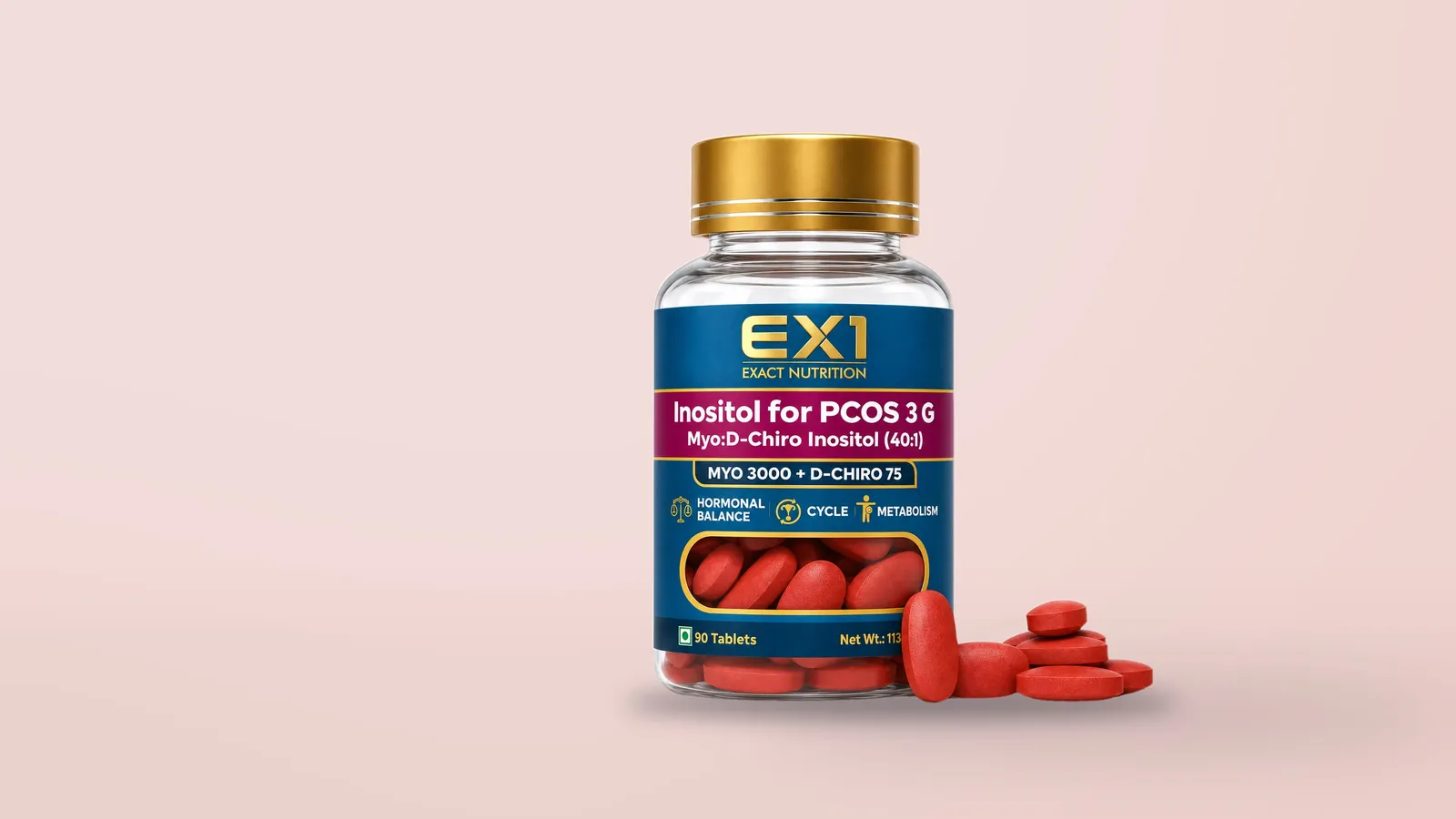
EX1 Inositol for PCOS gives 3,000 mg myo-inositol and 75 mg D-chiro-inositol a day, a 40:1 ratio, with folic acid and chromium. That is three tablets a day, taken with or after food.
Trials of myo-inositol alone used 1 to 4 g a day, and EX1's 3 g sits inside that range. The seven-ratio trial used 4 g of inositols a day, and EX1's daily total is about three quarters of that. The 2023 guideline does not endorse any dose or ratio. Read them as label facts, nothing more.
The claims EX1 makes rest on the formula's two nutrients. Folate contributes to normal homocysteine metabolism and to the reduction of tiredness and fatigue; chromium contributes to normal macronutrient metabolism.
If you take medication for blood sugar, consult your physician before use.
We print every milligram on the pack. For how a combined total can hide each dose, read what a proprietary blend is. If you are also weighing iron, read our guide to iron tablets for women.
Frequently asked questions
Myo-inositol kab lena chahiye, khane ke saath ya khali pet?
EX1's directions are three tablets a day with or after food. Both forms of inositol dissolve in water, and food mainly helps stomach comfort rather than absorption. So take them with a meal. If your doctor has given you a different schedule, follow that instead.
How long does myo-inositol take to show results?
Think in months. Trials of myo-inositol in PCOS typically ran three to six months. The 2023 international guideline sees limited clinical benefit overall, so agree with your doctor on what you are tracking, such as cycle dates, and when you will review it.
Can I take myo-inositol and D-chiro-inositol together?
Yes. Many PCOS products combine the two, most often at 40:1, the ratio reported in blood plasma. Researchers have raised questions about high D-chiro-inositol amounts, which is why ratio products keep it a small share. The 2023 international guideline does not recommend any specific type, dose or combination, so combining the two is an option it leaves to you.
Can I take myo-inositol with metformin?
Tell your doctor before you add myo-inositol, or any other supplement, to a prescription. The 2023 international PCOS guideline encourages anyone taking inositol to tell their healthcare professional.
Does myo-inositol help with PCOS weight loss?
The evidence is very uncertain. A 2022 meta-analysis of 17 trials and 1,083 women in Reproductive Sciences found no significant improvement in BMI. The 2023 international guideline also lists weight among the areas of limited clinical benefit. Inositol is not a weight-loss product.
Is myo-inositol safe in pregnancy or while breastfeeding?
Consult a physician before use if you are pregnant, lactating, on medication or have a medical condition. The 2023 international PCOS guideline notes that side effects and safety of inositol are not established. Make this call with your doctor.
Is 40:1 the only ratio that works?
No ratio has been shown to be the one that works. Other ratios, and myo-inositol alone, have been studied too. The case for 40:1 rests mostly on small studies, including one that compared seven ratios with eight women in each group. The 2023 international guideline does not recommend any specific ratio, 40:1 included.
Sources
- 2023 International Evidence-based Guideline for the Assessment and Management of PCOS (Human Reproduction, 2023): inositol could be considered based on personal preference, with limited harm and limited clinical benefit; no specific type, dose or combination can be recommended; side effects and safety not known; PCOS prevalence 10 to 13%; diagnostic criteria.
- Journal of Clinical Endocrinology and Metabolism, 2024: systematic review of 30 trials and 2,230 women behind the guideline; some metabolic benefit, evidence limited and inconclusive; myo-only trials used 1 to 4 g a day.
- BJOG, 2017: meta-analysis of 10 randomised trials; inositol associated with more frequent menstrual cycles than placebo; evidence for pregnancy or live birth lacking.
- Reproductive Biology and Endocrinology, 2023: meta-analysis of 26 trials; regular cycle more often than placebo, lower free testosterone, higher SHBG.
- Endocrine Connections, 2017: meta-analysis of nine trials; myo-inositol associated with lower fasting insulin and HOMA index.
- Reproductive Sciences, 2022: meta-analysis of 17 trials and 1,083 women; no significant improvement in BMI, fasting insulin, HOMA or total testosterone; high variation between studies.
- Frontiers in Endocrinology, 2021 (opinion article): myo- to D-chiro-inositol ratio reported at 40:1 in plasma and about 100:1 in follicular fluid; questions about high D-chiro-inositol amounts.
- European Review for Medical and Pharmacological Sciences, 2019: seven inositol ratios compared, eight women per group, 4 g of inositols a day for three months.
- International Journal of Endocrinology, 2016: randomised trial in 46 overweight women; 40:1 combination over six months associated with lower LH, free testosterone, fasting insulin and HOMA index against a folic-acid control.
- Gynecologic and Obstetric Investigation, 2024: single-group study of 34 women, 2,255 mg a day of inositols at 40:1 for three months.
- JAMA Network Open, 2024: national Indian study of women aged 18 to 40; PCOS prevalence about 7% to 20% depending on diagnostic criteria.