Magnesium L-Threonate Benefits: Deep Sleep, Memory and the Trials Behind Them
By Ayush Goyal, Founder, EX1
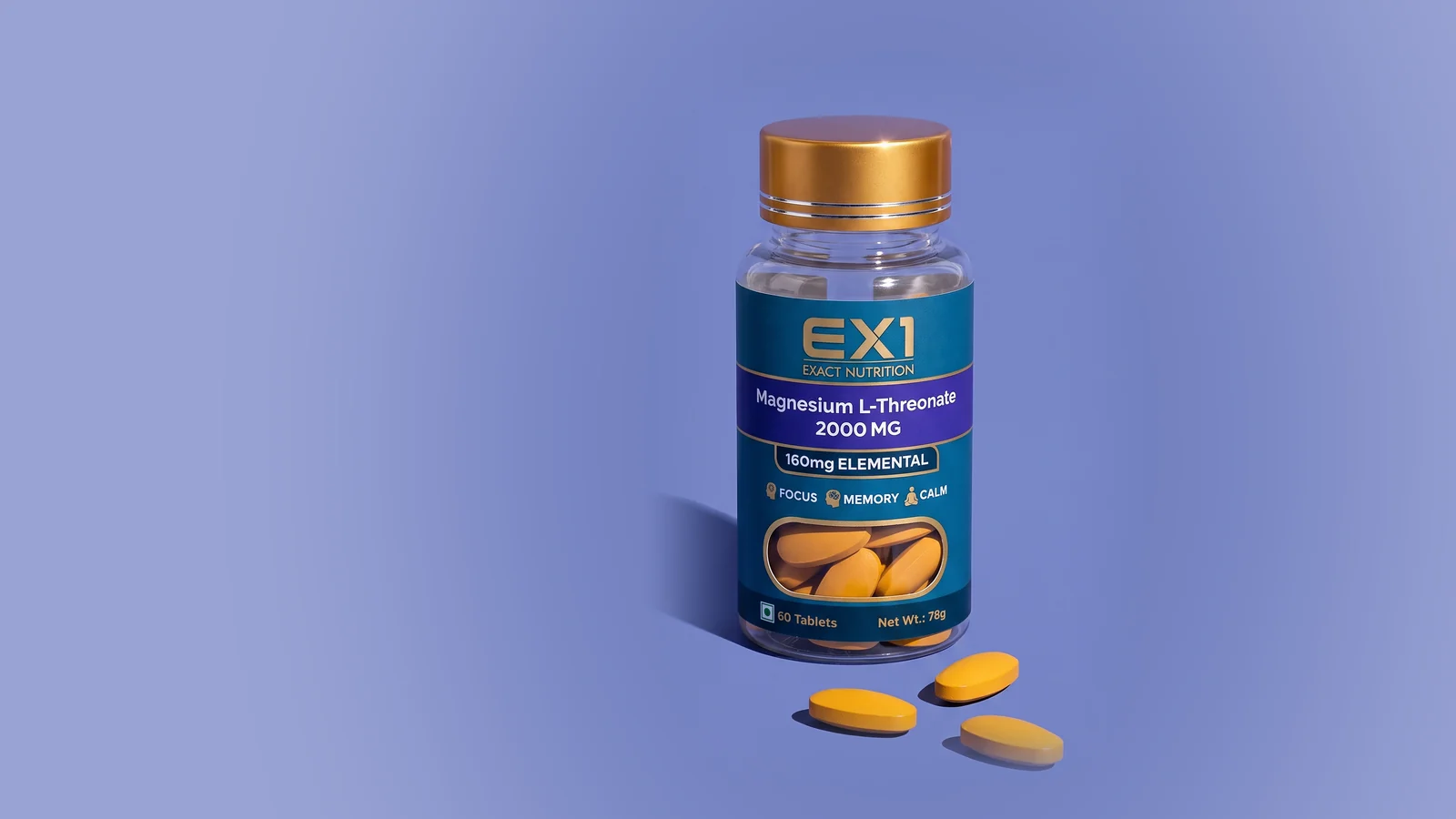
Magnesium L-threonate has been studied for deep sleep and thinking skills. The human trials are small and short, and the ingredient's maker was involved in the best-known ones. Here is each trial, its dose and who paid for it.
Magnesium L-threonate is a form of magnesium that has been studied for deep sleep and for thinking skills. The human trials are small and short, and the ingredient's maker was involved in the best-known ones.
This guide goes through each trial, the dose it used and who paid for it, so you can read the evidence yourself. The magnesium L-threonate benefits studied are deep sleep and thinking skills.
What is magnesium L-threonate, and how much magnesium does it contain?
Magnesium L-threonate is magnesium bound to L-threonate. It is about 8% magnesium by weight, so the magnesium is a small share of what a 2000 mg serving weighs. EX1's label states 160 mg of elemental magnesium from 2000 mg of the compound. Trials have used 1 g to 2 g of the compound a day.
Magnesium L-threonate weighs far more than the magnesium inside it, so the elemental figure is the one to read. Our guide to how to read elemental magnesium versus salt weight explains why a label can print 2000 mg while the magnesium inside is 160 mg.
According to ICMR-NIN (2020), the RDA for magnesium is 440 mg a day for adult men and 370 mg a day for adult women. A 160 mg serving is 36.4% of the men's figure.
Does magnesium L-threonate help deep sleep?
The sleep evidence is mixed and comes from small trials. A 2024 trial in Sleep Medicine: X, at 1 g a day for three weeks, reported better deep sleep and REM sleep scores than placebo. A 2026 trial at 2 g a day for six weeks found no difference in sleep disturbance. The ingredient's maker was involved in both.
The 2024 trial measured sleep with a consumer sleep ring, and the ring's deep sleep and REM sleep scores improved more than placebo. It gave 80 adults aged 35 to 55 with self-reported sleep problems 1 g of magnesium L-threonate a day for three weeks. One of the principal investigators was an executive at the ingredient's maker.
The 2026 trial, published in Frontiers in Nutrition, gave 100 adults aged 18 to 45 with unsatisfying sleep 2 g a day for six weeks. It found no difference between groups in sleep disturbance, and a greater improvement in sleep-related daytime impairment. The ingredient's maker funded it.
A small 2016 trial of 44 adults aged 50 to 70, published in a peer-reviewed neuroscience journal, found that sleep and anxiety scores did not differ from placebo. The ingredient's developer funded and co-designed it.
Our read: the sleep ring's scores moved at 1 g, and self-reported sleep disturbance did not move at 2 g. Both trials were short and tied to the ingredient's maker, so treat the deep sleep result as a lead that needs more trials.
Does magnesium L-threonate help memory and thinking skills?
The memory research starts in rats and continues in small human trials. A 2016 trial of 44 adults aged 50 to 70 found larger gains than placebo on a combined test of thinking skills after 12 weeks. A 2026 trial at 2 g a day reported gains in overall cognition and reaction time. Makers funded or co-designed both.
The memory story began with a rat study. In rats, a 2010 study in Neuron found that this form raised magnesium in the brain and that the animals given it performed better on learning tasks. That is animal work. None of the human trials discussed here measured brain magnesium directly.
The first human trial was small and measured thinking skills as one combined score. In 2016, 44 adults aged 50 to 70 who reported trouble with concentration and memory took a magnesium L-threonate product for 12 weeks. It was associated with larger gains than placebo on a combined test of thinking skills. Sleep and anxiety scores did not differ from placebo. The ingredient's developer funded and co-designed the trial.
A 2022 trial in Nutrients gave 109 healthy adults a combination formula of magnesium L-threonate with phosphatidylserine, vitamin D3, vitamin C and vitamin B6 for 30 days; the formula group scored higher on memory tests than placebo. Because it was a combination, the result cannot be credited to threonate alone, and the ingredient's maker funded it.
The trial closest to EX1's dose, published in Frontiers in Nutrition in 2026, gave 100 adults aged 18 to 45 a 2 g daily dose for six weeks. It was associated with greater gains than placebo on an overall cognition score and on reaction time. The tests were of attention and reaction time. The ingredient's maker funded it.
What did each trial use, and who paid for it?
Four human trials sit behind the claims for magnesium L-threonate. Where a dose is stated they used 1 g to 2 g of the compound a day, for 3 to 12 weeks, in 44 to 109 adults. In each, the ingredient's maker or developer funded the trial, co-designed it, or employed a principal investigator.
| Trial | Who took part | Dose and length | What it reported | Link to the maker |
|---|---|---|---|---|
| A 2016 randomised trial, peer-reviewed neuroscience journal | 44 adults aged 50 to 70 with trouble with concentration and memory | A magnesium L-threonate product, 12 weeks | Larger gains than placebo on a combined test of thinking skills; sleep and anxiety scores did not differ | The developer funded and co-designed it |
| Nutrients, 2022 | 109 healthy adults | A combination formula with 1.6 g of magnesium L-threonate, 30 days | Higher memory test scores than placebo; cannot be credited to threonate alone | The maker funded it |
| Sleep Medicine: X, 2024 | 80 adults aged 35 to 55 with self-reported sleep problems | 1 g a day, 3 weeks | Deep sleep and REM sleep scores on a sleep ring improved more than placebo | A principal investigator was an executive at the maker |
| Frontiers in Nutrition, 2026 | 100 adults aged 18 to 45 with unsatisfying sleep | 2 g a day, 6 weeks | Greater gains in overall cognition and reaction time; no difference in sleep disturbance | The maker funded it |
Magnesium L-threonate per day in the trials (grams of the compound)
- 2024 trial, three weeks1 g
Sleep Medicine: X, 2024
- 2022 trial, inside a combination formula1.6 g
Nutrients, 2022
- 2026 trial, six weeks2 g
Frontiers in Nutrition, 2026
- EX1: two tablets a day, 160 mg elemental magnesium2 g
EX1 label
What do we not know about magnesium L-threonate?
Four limits apply to this evidence. The trials ran from 3 to 12 weeks. None measured brain magnesium directly. The maker or developer was involved in each trial that reports a benefit. And the combination trial cannot be credited to magnesium L-threonate alone.
- Length: the trials ran from 3 to 12 weeks, so they say little about use over many months.
- Mechanism: no human trial here measured magnesium in the brain.
- Independence: the maker or developer funded, co-designed or employed a principal investigator in each trial above.
- Dose: the trials used 1 g to 2 g of the compound, and a result at one dose does not carry over to another.
Is magnesium L-threonate safe? Side effects and who should check with a doctor first
Magnesium L-threonate was well tolerated in short trials of 3 to 12 weeks. The US upper limit for magnesium from supplements and medicines is 350 mg a day for adults, and food magnesium does not count toward it. Check with a doctor first if you take antibiotics, bone medicines, diuretics or long-term acid-reflux medicines, or have reduced kidney function.
Well tolerated in short trials does not rule out side effects. Add up the elemental magnesium on every supplement you take, because the 350 mg limit counts them all together.
Magnesium can reduce the absorption of some antibiotics and of bone medicines called bisphosphonates if taken too close together. Some diuretics change magnesium loss, and long-term acid-reflux medicines can lower magnesium. Check timing with your doctor or pharmacist.
People with reduced kidney function are at greater risk of too much magnesium, so ask a doctor before taking any magnesium supplement.
Consult a physician before use if pregnant, lactating, on medication or with a medical condition. Not to be used by children. A supplement complements, never replaces, diet, movement and medical care.
When should you take magnesium L-threonate?
The label says to take 2 tablets a day, preferably in the evening, with or without food. Some people split the dose, one tablet in the morning and one in the evening. The trials ran from 3 to 12 weeks, so judge it over weeks rather than nights.
Magnesium L-threonate is taken daily, and the trials measured weeks, not single nights. The product page suggests a check after four to eight weeks: your sleep tracker's deep sleep score, if you wear one, and a free online reaction-time test, taken before you start and again later.
How EX1 fits
EX1 Magnesium L-Threonate gives 2000 mg of magnesium L-threonate in a two-tablet serving, which states 160 mg of elemental magnesium, 36.4% of the ICMR-NIN (2020) RDA for adult men. The label says 2 tablets a day, preferably in the evening, with or without food. A bottle holds 60 tablets, which is 30 servings.
The 2 g serving is the compound weight used in the 2026 trial. We do not claim the product reproduces that result.
The claims EX1 makes rest on magnesium itself: magnesium contributes to the normal functioning of the nervous system and to normal psychological function.
We print the salt weight and the elemental weight on purpose, so you can read both.
Related reading: magnesium for sleep: what the evidence shows and L-theanine benefits.
Frequently asked questions
What is the best time to take magnesium L-threonate?
The label says preferably in the evening, with or without food. Some people split the two daily tablets, one in the morning and one in the evening, for steadier intake through the day.
How long does magnesium L-threonate take to work?
The trials ran from 3 to 12 weeks, and none promises a result by a set date. The product page suggests checking in at four to eight weeks, using a sleep tracker's deep sleep score or a free reaction-time test taken before you start.
Can I take magnesium L-threonate every day?
The label says two tablets a day. The trials covered here ran from 3 to 12 weeks, so they cannot tell us about use over many months. Check with your doctor if you plan to take any supplement long term.
Does magnesium L-threonate reach the brain in people?
In rats, a 2010 study in Neuron found that this form raised magnesium in the brain. None of the human trials discussed here measured brain magnesium directly, so we do not say it does in people.
Can I take magnesium L-threonate with other magnesium supplements?
Add up the elemental magnesium on every label first. The US upper limit for magnesium from supplements and medicines is 350 mg a day for adults, and magnesium from food does not count toward it. Ask your doctor if you are unsure.
Does magnesium L-threonate interact with medicines?
Magnesium can reduce the absorption of some antibiotics and of bone medicines called bisphosphonates if taken too close together. Some diuretics change magnesium loss, and long-term acid-reflux medicines can lower magnesium. Check timing with your doctor or pharmacist.
Is magnesium L-threonate safe in pregnancy or while breastfeeding?
Consult a physician before use if you are pregnant or breastfeeding.
Magnesium L-threonate kab lena chahiye?
Label ke hisaab se din mein 2 tablet, shaam ko lena behtar hai, khane ke saath ya bina khaye. Chaahein toh ek tablet subah aur ek shaam ko bhi le sakte hain. Trials 3 se 12 hafte ke the, isliye nateeja hafton mein dekhein, ek raat mein nahi.
Sources
- Neuron, 2010: rat study; magnesium L-threonate raised brain magnesium and the animals given it performed better on learning tasks.
- ICMR-NIN, 2020: brief note on nutrient requirements for Indians (RDA); magnesium 440 mg a day for adult men and 370 mg for adult women.
- A 2016 randomised trial published in a peer-reviewed neuroscience journal: 44 adults aged 50 to 70 with trouble with concentration and memory; 12 weeks; larger gains than placebo on a combined test of thinking skills; sleep and anxiety scores did not differ; developer-funded and co-designed.
- Nutrients, 2022: 109 healthy adults; a combination formula of magnesium L-threonate, phosphatidylserine, vitamin D3, vitamin C and vitamin B6; 30 days; higher memory test scores than placebo; maker-funded.
- Sleep Medicine: X, 2024: 80 adults aged 35 to 55 with self-reported sleep problems; 1 g a day for 21 days; deep sleep and REM sleep scores on a sleep ring improved more than placebo; a principal investigator was an executive at the ingredient's maker.
- Frontiers in Nutrition, 2026: 100 adults aged 18 to 45 with unsatisfying sleep; 2 g a day for six weeks; greater gains in overall cognition and reaction time; no difference in sleep disturbance; greater improvement in sleep-related daytime impairment; maker-funded.
- NIH Office of Dietary Supplements: magnesium fact sheet; upper limit of 350 mg a day from supplements and medicines for adults; interactions with antibiotics, diuretics and acid-reflux medicines.
- StatPearls, updated July 2026: magnesium toxicity; reduced kidney function is a risk factor.