L-Theanine Benefits: Calm Focus, Caffeine and Dose
By Ayush Goyal, Founder, EX1
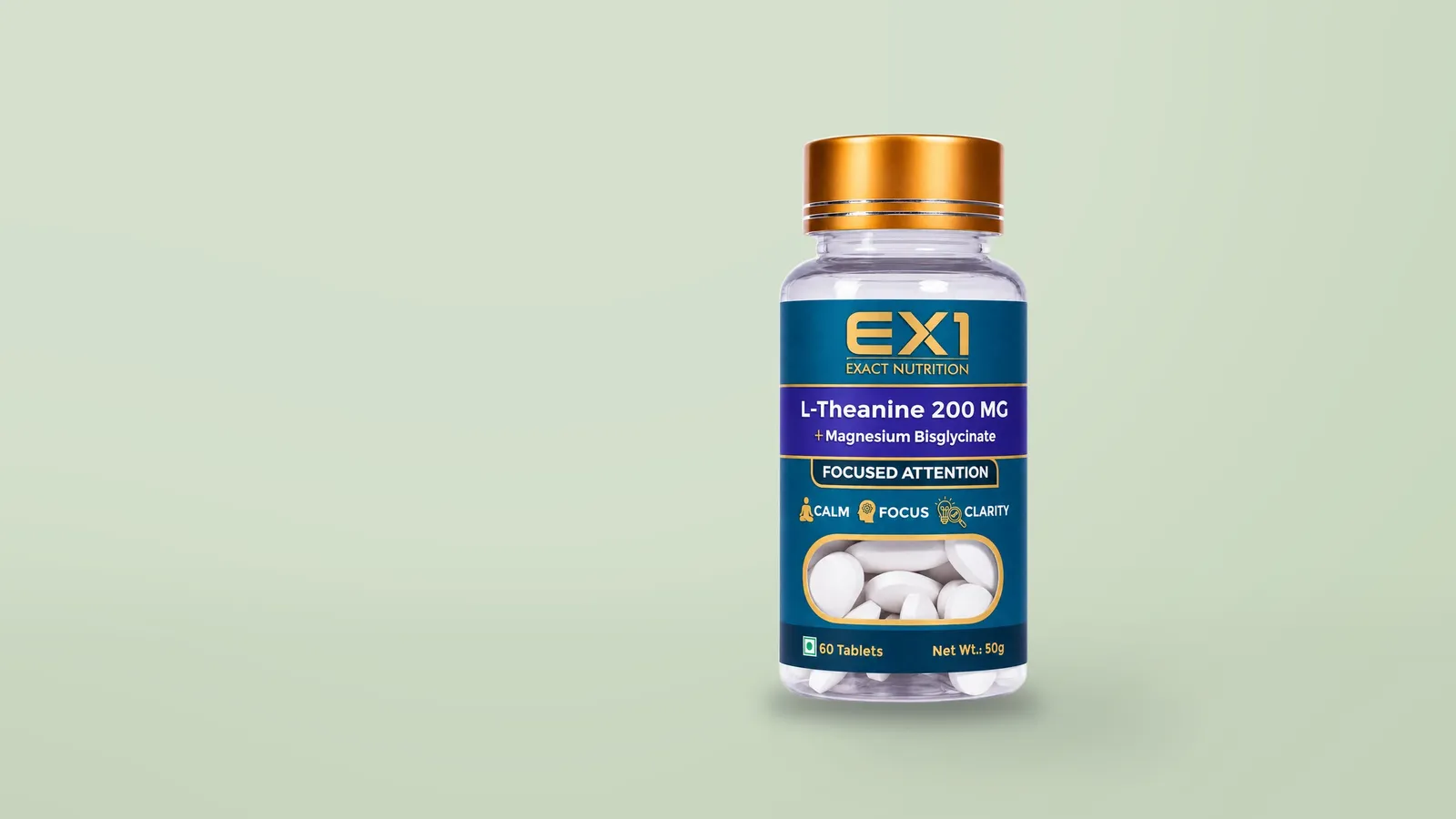
L-theanine is the amino acid in tea that people take for calm, alert focus. We read the trials with and without caffeine, the mixed sleep evidence, and how 200 mg compares with a cup of tea.
L-theanine is an amino acid found in tea, taken as a supplement for calm, alert focus. Its strongest evidence is for L-theanine taken with caffeine, where pooled trials found small-to-moderate gains on attention tasks within two hours. The evidence for L-theanine alone, and for sleep, is smaller and more mixed.
Two things decide what a result means: the dose, and whether caffeine was in the cup.
L-theanine benefits, as the trials measured them, are mainly calm, alert focus and stress responses.
What is L-theanine?
L-theanine is an amino acid found naturally in tea leaves. A standard 200 ml cup of black tea contained about 24 mg on average in one study of UK supermarket teas, and green tea about 8 mg. As a supplement, L-theanine is taken for calm, alert focus, and research doses typically sit around 200 mg a day.
L-theanine is an amino acid that tea plants make. Every cup carries a little. A supplement gives a measured dose.
As of October 2026, L-theanine carries no authorised health claim. So this post sticks to what trials measured. It cannot tell you how you will feel.
What are the benefits of L-theanine?
L-theanine's benefits are studied mainly for focus and stress. Pooled trials of L-theanine with caffeine found small-to-moderate gains on attention tasks within two hours. Pooled trials of L-theanine alone, typically at 200 mg, found a small speed-up on one reaction-time task. A 2025 review called the sleep evidence inconclusive.
A benefit, in this post, means a result a trial measured. For stress, a 2020 systematic review concluded that 200 to 400 mg a day may help with stress responses, and asked for more research.
Our read: the firmest evidence sits with the caffeine pairing. Everything else is thinner.
Does L-theanine help you focus?
L-theanine alone has limited focus evidence. Pooled trials, typically at 200 mg, found a small speed-up on a reaction-time task in the first hour. In one 2008 trial, 250 mg of L-theanine alone raised headache ratings and lowered scores on a subtraction task. Most of the focus evidence is for L-theanine paired with caffeine.
Focus, in these studies, means scores on timed attention tasks in a lab. None of them measured exam marks or a working day, so read "L-theanine for studying" reels with care.
A small 2008 EEG report in the Asia Pacific Journal of Clinical Nutrition found that 50 mg of L-theanine in tea raised alpha-wave activity, a pattern linked to relaxed wakefulness, compared with water. It was a short report in 35 people that did not test focus or performance.
People also search for L-theanine for ADHD. ADHD is a medical condition, so that question belongs with your doctor.
Why are L-theanine and caffeine taken together?
L-theanine and caffeine are taken together because most of the focus evidence comes from that pairing. A 2025 Nutrition Reviews analysis found small-to-moderate gains on attention tasks within two hours of taking both, with wide uncertainty. Those trials used a median of 82 mg of L-theanine.
A combination trial tests two ingredients taken together, so its result belongs to the pair. Neither ingredient gets the credit alone. The 2025 authors noted that the confidence intervals often left the size and direction of the effect uncertain.
| Study | L-theanine | Caffeine | Who | What changed |
|---|---|---|---|---|
| Nutritional Neuroscience, 2008 | 100 mg | 50 mg | 27 healthy volunteers | Faster and more accurate attention switching at 60 minutes; less thrown by distraction on a word task at 60 and 90 minutes |
| Nutritional Neuroscience, 2010 (industry-funded) | 97 mg | 40 mg | 44 young adults | More accurate attention switching than placebo; more alert, less tired |
| Biological Psychology, 2008 | 250 mg | 150 mg | Each dose tested alone and together | The pair: faster reaction times, including on a number-recall task, and lower "headache" and "tired" ratings |
| Biological Psychology, 2008 | 250 mg | None | Same trial, L-theanine alone | Higher "headache" ratings, lower subtraction scores |
| Nutrition Reviews, 2025 (pooled) | Median 82 mg | Yes | Healthy people | Small-to-moderate attention gains within two hours, often uncertain |
Your 8 am chai or filter coffee already has caffeine in it. These fixed-dose lab trials cannot tell you what that cup plus a separate L-theanine tablet will do.
Does L-theanine help with stress?
L-theanine may help with stress responses, according to a 2020 systematic review of nine studies in Plant Foods for Human Nutrition, which concluded that 200 to 400 mg a day may help and that more research is needed. A very small 2007 lab study found one dose blunted heart-rate responses to a stressful task.
A stress response is how your body reacts to pressure, such as a faster heart rate. The 2007 study in Biological Psychology was tiny: 12 people. A single 200 mg dose of L-theanine blunted their heart-rate and salivary-marker responses to a stressful arithmetic task, compared with placebo. Twelve people is a starting point, nothing more.
The one trial we found in adults with a clinical anxiety condition (Journal of Psychiatric Research, 2019) gave 450 to 900 mg a day alongside their existing medicine for 8 weeks. It did not outperform placebo on the main anxiety scale. Anything clinical is a question for your doctor.
Does L-theanine help you sleep?
L-theanine's sleep evidence is mixed. A 2025 meta-analysis in Sleep Medicine Reviews found small improvements in self-reported sleep, but most trials did not test pure L-theanine. A 2025 Nutrition Reviews analysis of healthy people called the sleep evidence for tea, theanine with caffeine, or theanine alone inconclusive.
Self-reported sleep means people rated their own sleep on a questionnaire, not in a lab. The Sleep Medicine Reviews authors say the right dose and duration are still unknown. The Nutrition Reviews analysis was limited to trials in healthy people, and most of them were industry-funded. In a small, industry-funded 4-week trial (Nutrients, 2019), 30 healthy adults taking 200 mg a day at bedtime reported lower scores on mood, stress and sleep questionnaires during the L-theanine period. In the same trial, three sleep-questionnaire scores, time to fall asleep, sleep disturbance and use of sleep aids, improved more than with placebo. Cognitive test scores rose during the L-theanine period, but not significantly more than on placebo. No significant side effects were reported over the 4 weeks.
Our read: the sleep evidence is too mixed to sell L-theanine as a sleep aid, so we put calm focus first. It is not a sedative. For sleep, our post on magnesium and sleep covers a different evidence base.
How much L-theanine should you take a day?
Most L-theanine research uses about 200 mg a day. A 2020 systematic review covered 200 to 400 mg a day, and pooled trials of L-theanine alone used a median of 200 mg. Trials pairing it with caffeine used less, a median of 82 mg. No study here showed that a higher dose works better.
The studied dose is the amount a trial gave, and the only dose its results describe. A 2026 US FDA GRAS notice summarised human trials at up to 900 mg a day. Read that as a safety summary. It says nothing about how much you should take.
How much L-theanine is in a cup?
- Green tea, one 200 ml cup7.9 mg
Food Chemistry, 2011 (SD 3.8)
- Black tea, one 200 ml cup24.2 mg
Food Chemistry, 2011 (SD 5.7)
- Dose in the alpha-wave EEG report50 mg
Asia Pacific Journal of Clinical Nutrition, 2008
- Median dose in caffeine-plus-theanine trials82 mg
Nutrition Reviews, 2025
- Median dose in theanine-only trials200 mg
Nutrition Reviews, 2025
- One EX1 tablet200 mg
Product label
Tea figures are averages for the UK supermarket teas tested in one study. Milk chai was not measured.
How much L-theanine is in a cup of tea?
A standard 200 ml cup of black tea contained 24.2 mg of L-theanine on average, and green tea 7.9 mg, in a 2011 Food Chemistry study of UK supermarket teas. By our arithmetic from those averages, 200 mg equals roughly eight cups of black tea. Indian milk chai was not measured.
Tea is the natural source of L-theanine, but the amount per cup is small. The 2011 study averaged 17 black teas and only 3 green teas. The eight-cup figure is our own arithmetic: 200 divided by 24.2. Green tea works out to about 25 cups. Boiled chai with milk and sugar, the way most of India drinks tea, was not tested. So we have no per-cup figure for your 4 pm cutting chai, and we would rather say so than guess.
Is L-theanine safe to take every day?
L-theanine was well tolerated in the trials we found. A 2026 US FDA GRAS notice summarised human trials at up to 900 mg a day, for up to 12 weeks, as well tolerated with no serious adverse events. We found no published studies of dependence or withdrawal. One trial reported higher headache ratings with L-theanine alone.
GRAS stands for "generally recognised as safe", a US route for food ingredients. FDA raised no questions on that 2026 notice. That safety summary is the notifier's own, not an FDA finding. Nor does the notice make L-theanine "FDA approved".
Because we found no studies of dependence or withdrawal, we do not call L-theanine "non-addictive". The headache signal comes from the 2008 Biological Psychology trial, at 250 mg of L-theanine alone. It is one finding in one study.
Consult a physician before use if pregnant, lactating, on medication or with a medical condition. Not to be used by children. If you take prescription medicine for mood, sleep or blood pressure, speak to your doctor first.
L-theanine benefits: the short version
The strongest support is for focus when L-theanine is taken with caffeine. Taken alone, pooled trials found a small speed-up on one reaction-time task, a 2020 review said 200 to 400 mg a day may help with stress responses, and the sleep evidence is mixed. As of October 2026, L-theanine carries no authorised health claim.
How EX1 fits
EX1 L-Theanine contains 200 mg of free-form L-theanine and 110 mg of elemental magnesium, from 500 mg of magnesium glycinate chelate, in one tablet a day. The 200 mg sits at the bottom of the 2020 review's range and matches the median dose in theanine-only trials. It has no caffeine and no GABA.
The magnesium carries the product's claim: magnesium contributes to normal psychological function and to the reduction of tiredness and fatigue. L-theanine has none of its own. Our guide to reading a magnesium label explains why the label shows both 500 mg and 110 mg.
We found no published trial of L-theanine paired with magnesium alone, so we do not claim the two work together. EX1 says one tablet daily with or after food, and suggests the morning, before a focused work session.
Frequently asked questions
How long does L-theanine take to work?
The single-dose trials measured results within the first two hours. In a 2008 Nutritional Neuroscience trial of L-theanine with caffeine, attention changes showed at 60 minutes, and fewer distraction effects at 60 and 90 minutes. Pooled trials of L-theanine alone found a small reaction-time effect in the first hour.
Can I take L-theanine with my morning coffee?
Most L-theanine focus research tested that pairing at fixed doses: 100 mg with 50 mg of caffeine in one trial, 97 mg with 40 mg in another. None of them tested a separate L-theanine tablet with your own coffee, so we cannot tell you that combination reproduces their results. If coffee already makes you jittery, ask your doctor.
Is L-theanine addictive or habit forming?
We found no published studies of dependence or withdrawal for L-theanine. The trials we found, lasting up to 12 weeks, reported no serious side effects. Take it as the label directs: one tablet a day, without exceeding the recommended daily amount.
Can I take L-theanine with magnesium glycinate?
We found no published trial of L-theanine paired with magnesium alone, so we make no claim that the two work together. Magnesium has its own authorised role: it contributes to normal psychological function and to the reduction of tiredness and fatigue. Our post on magnesium for sleep covers that evidence, and our guide to magnesium glycinate benefits covers the mineral itself.
Can I take L-theanine with ashwagandha?
We did not review any trial of L-theanine and ashwagandha taken together, so we make no claim about the pair. Read each one's evidence separately, starting with our guide to how to read an ashwagandha label. For the full ashwagandha picture, see ashwagandha for stress. Check with your doctor if you take other medicines.
Who should not take L-theanine?
Consult a physician before use if you are pregnant, breastfeeding, on medication or have a medical condition, and do not give it to children. That includes prescription medicine for mood, sleep or blood pressure. In one 2008 trial, 250 mg of L-theanine alone raised headache ratings. Stop and see a doctor if anything concerns you.
L-theanine kab lena chahiye, subah ya raat ko?
Focus wale trials mein L-theanine din mein diya gaya tha, aur results 60 se 90 minute baad naape gaye the. EX1 kehta hai: roz ek tablet, khane ke saath ya khane ke baad, aur subah lena best hai, kisi focused kaam se pehle. Sleep par research abhi mixed hai, isliye hum ise sleep tablet ki tarah nahi bechte.
L-theanine tablet uses in Hindi: yeh kya kaam karta hai?
L-theanine chai ki patti mein milne wala amino acid hai, jo calm focus ke liye liya jata hai. 2020 ki ek review ke mutabik 200 se 400 mg roz stress responses mein madad kar sakta hai, lekin aur research chahiye. Caffeine ke saath liye gaye trials mein do ghante ke andar attention tasks par chhota fayda dikha.
Sources
- Plant Foods for Human Nutrition, 2020: systematic review of nine studies; 200 to 400 mg of L-theanine a day may help with stress responses, more research needed.
- Biological Psychology, 2007: lab study in 12 people; a single dose of L-theanine blunted heart-rate and salivary-marker responses to a stressful arithmetic task versus placebo.
- Journal of Psychiatric Research, 2019: 8-week trial of 450 to 900 mg a day added to existing medicine in adults with a clinical anxiety condition; no difference from placebo on the main anxiety scale.
- Sleep Medicine Reviews, 2025: meta-analysis of L-theanine and sleep; small improvements in self-reported sleep, mostly from trials that did not test pure L-theanine.
- Nutrition Reviews, 2025: systematic review and meta-analysis of trials in healthy people; caffeine plus L-theanine gave small-to-moderate attention gains within two hours, L-theanine alone a small first-hour reaction-time effect, and sleep evidence was inconclusive.
- Nutritional Neuroscience, 2008: 27 healthy volunteers given 100 mg L-theanine with 50 mg caffeine; faster, more accurate attention switching at 60 minutes.
- Nutritional Neuroscience, 2010: industry-funded trial in 44 young adults of 97 mg L-theanine with 40 mg caffeine; more accurate attention switching, more alertness, less tiredness.
- Biological Psychology, 2008: 250 mg L-theanine and 150 mg caffeine, alone and together; the pair sped reaction times, L-theanine alone raised headache ratings.
- Asia Pacific Journal of Clinical Nutrition, 2008: short EEG report in 35 people; 50 mg of L-theanine in tea raised alpha-wave activity versus water.
- Food Chemistry, 2011: L-theanine content of UK supermarket teas; 24.2 mg per 200 ml cup of black tea, 7.9 mg for green tea.
- US Food and Drug Administration, 2026: GRAS notice response letter for L-theanine; the notifier summarised trials up to 900 mg a day for up to 12 weeks with no serious adverse events, and FDA raised no questions.
- Nutrients, 2019: 30 healthy adults, 200 mg of L-theanine a day at bedtime for 4 weeks; industry-funded.