Vitamin C Tablets: Immunity, Skin, and Why More Is Not Better
By Ayush Goyal, Founder, EX1
Vitamin C tablets support normal immune function and collagen formation, but most adults need far less than a 1,000 mg tablet. We cover the RDA, where absorption tails off and what the cold and skin research shows.
Vitamin C tablets supply a nutrient that contributes to normal immune function, normal collagen formation and the protection of cells from oxidative stress. Most adults need far less than the 1,000 mg tablets common on the shelf: ICMR-NIN (2020) sets the daily RDA at 80 mg for men and 65 mg for women.
More is not better, and one careful study shows why. Immune cells were full of vitamin C at 100 mg a day. Above a single 500 mg dose, the body absorbed less and passed the extra in urine.
What are the benefits of vitamin C tablets?
Vitamin C tablets provide a nutrient that contributes to normal immune function, normal collagen formation and the protection of cells from oxidative stress. A 2017 review notes that low intake impairs immune function, and suggests 100 to 200 mg a day from all sources for everyday immune defence.
Vitamin C is a water-soluble vitamin your body cannot make, so it has to come from food or a supplement. That review, in Nutrients, notes that vitamin C builds up in white blood cells such as neutrophils. Its 100 to 200 mg range is total intake, so food fills the gap above an 80 mg supplement: a guava from the thela, nimbu over your dal, a piece of amla.
That is the answer to "vitamin C for which purpose": daily support for normal function.
Vitamin C tablets benefits start with that everyday role. The useful questions after it are how much you need, and where more stops helping.
How much vitamin C do you need in a day?
ICMR-NIN (2020) sets the vitamin C RDA at 80 mg a day for adult men and 65 mg a day for adult women. As of October 2026, these are the current Indian figures, and they cover food and supplements combined.
The RDA is the daily amount that covers almost every healthy adult. An 80 mg dose is the full men's RDA. For a woman it is about 123% of hers.
Low intake does show up in Indian data. In a 2011 population survey in PLoS ONE of people aged 60 and over, low vitamin C affected 73.9% in north India. In south India the figure was 45.7%. Those figures are for older adults in that one survey, so read them with your parents in mind.
What happens to vitamin C above 100 mg a day?
Vitamin C absorption tails off as the dose rises. In a 1996 study in PNAS, immune cells were full of vitamin C at 100 mg a day. A single 200 mg dose was fully absorbed. At single doses of 500 mg and above, absorption fell and the extra was passed in urine.
Saturation is the point where cells or blood hold as much vitamin C as they can. The study was tiny. Seven healthy volunteers stayed in hospital for four to six months on doses from 30 to 2,500 mg a day.
Blood plasma was completely saturated only at 1,000 mg a day. Six of the seven volunteers passed no vitamin C in urine until the 100 mg dose. The authors concluded that daily doses above 400 mg have no evident value. At 1,000 mg a day, oxalate and urate in urine rose.
80 mg sits just below the point where immune cells were measured as full. The study did not measure how much of an 80 mg dose is absorbed, so we quote no percentage.
Where 80 mg sits on the vitamin C dose ladder
- 55 mgAverage requirement, adult women (ICMR-NIN 2020)
- 65 mgRDA, adult women (ICMR-NIN 2020)
- 80 mgRDA, adult men (ICMR-NIN 2020); the EX1 dose
- 100 mgImmune cells full; urine loss begins (PNAS 1996)
- 100 to 200 mgTotal daily intake suggested for everyday immune defence (Nutrients 2017)
- 200 mgSingle dose fully absorbed (PNAS 1996)
- 400 mg"No evident value" above this, per the study authors (PNAS 1996)
- 500 mg and aboveSingle doses less absorbed (PNAS 1996)
- 1,000 mgPlasma completely saturated (PNAS 1996); in men, supplements at this level linked to about 19% higher kidney stone risk (American Journal of Kidney Diseases 2016)
- 2,000 mgUpper limit (MSD Manual)
Do vitamin C tablets help your skin?
Vitamin C contributes to normal collagen formation, and it is a co-factor for the enzymes that stabilise collagen. Skin draws its vitamin C from the blood. One study cited in a 2017 Nutrients review suggests skin levels stop rising once blood levels are full, and whether supplements beat a good diet is poorly understood.
Collagen is the protein that gives skin its structure. Our post on marine collagen and vitamin C for skin covers that pairing.
People search "vitamin C tablets for skin glow" hoping for a visible change. No study in this post shows a tablet producing one. The evidence backs something plainer, which is enough vitamin C each day for normal collagen formation.
Can vitamin C tablets change your skin tone?
Vitamin C tablets are not shown to change skin colour. One study suggests skin vitamin C stops rising once blood levels are full, so a bigger dose is not expected to push more into skin. For pigmentation or uneven patches, daily sun protection and a dermatologist are the honest route.
Skin tone is the natural colour of your skin, and no source here shows an oral vitamin C tablet changing it. We don't sell vitamin C for it.
If dark patches, marks or uneven tone bother you, a dermatologist can find the cause.
Why take vitamin C with zinc?
Vitamin C and zinc both contribute to normal immune function, so many vitamin C zinc tablets pair them. ICMR-NIN (2020) sets the zinc RDA at 17 mg a day for adult men and 13 mg for adult women. A 2017 Nutrients review describes zinc as essential for the immune system to function.
Zinc is a trace mineral your immune system needs to work normally. A 2024 Cochrane review of zinc (34 studies, 8,526 people) found zinc may make little or no difference to whether people catch a cold. Used once a cold had started, it may shorten it by about two days. That is low-certainty evidence, and non-serious side effects were more common. Most of it comes from lozenges and other forms taken during a cold, not from a once-daily swallowed tablet.
In seven trials of zinc lozenges (575 people, JRSM Open 2017), colds were about a third shorter. Those lozenges gave 80 to 207 mg of zinc a day, dissolved in the mouth, and were taken only while ill. A swallowed 17 mg daily tablet is a different thing, and that result does not transfer.
Does vitamin C stop you catching a cold?
Vitamin C taken daily did not cut how often people caught a cold, according to a 2013 Cochrane review covering 10,708 people in the general community (risk ratio 0.97). In trials of 200 mg a day or more, colds were about 8% shorter in adults and 14% shorter in children.
A Cochrane review is a systematic review that pools the trials on one question. No trial in this one tested a dose as low as 80 mg.
The exception was people under heavy short-term physical stress. In five trials of 598 marathon runners, skiers and soldiers on subarctic exercises, cold risk roughly halved.
Starting vitamin C after a cold had begun showed no consistent effect on how long it lasted or how bad it was. So the fizzy 1,000 mg tablet at the first sneeze has little trial support. Our read: the cold benefit is small, and it belongs to daily intake at 200 mg or more.
Vitamin C tablets side effects: can you take too much?
Vitamin C has an upper limit of 2,000 mg a day, according to the MSD Manual, and above it nausea and diarrhoea can occur. High doses can raise oxalate in urine. In large US cohorts, supplemental vitamin C at 1,000 mg a day or more was linked to about 19% higher kidney stone risk in men.
The upper limit is the highest daily intake unlikely to cause side effects in most adults. The 2,000 mg figure is a US one, not an ICMR-NIN one. In people with thalassaemia or haemochromatosis, vitamin C can promote iron overload. How vitamin C changes the iron you absorb from a meal is covered in vitamin C and iron absorption.
The kidney stone figure comes from US cohorts followed for about 11 years (American Journal of Kidney Diseases, 2016). No significant link was seen in women. This is an association, and 80 mg was not studied as its own group.
Check with a doctor first if you have had kidney stones, have thalassaemia or haemochromatosis, are pregnant or breastfeeding, or take regular medication. Add up the vitamin C and zinc in everything you take, multivitamin included.
Why 80 mg and not 1,000 mg?
An 80 mg vitamin C tablet matches the ICMR-NIN 2020 RDA for men, and a 1,000 mg tablet gives more than twelve times that. In a 1996 study, immune cells were full at 100 mg a day, single doses of 500 mg and above were less absorbed, and the authors saw no evident value above 400 mg.
A gentle dose, in our sense, is a dose matched to the RDA, with food supplying the rest. The word is about milligrams, not stomach comfort. No trial has compared that.
| What was measured | 80 mg a day | 1,000 mg a day |
|---|---|---|
| Share of men's RDA (ICMR-NIN 2020) | 100% | 1,250% |
| Immune cells (PNAS 1996) | Just below the 100 mg full point | Above it |
| Blood plasma (PNAS 1996) | Not saturated | Completely saturated |
| Urine (PNAS 1996) | Below the 100 mg point where loss began | Oxalate and urate rose |
| Kidney stone link in men (American Journal of Kidney Diseases 2016) | Not studied as its own group | About 19% higher risk |
| Share of the 2,000 mg upper limit (MSD Manual) | 4% | 50% |
Our read: a 1,000 mg tablet sits under the upper limit, and the stone figure is an association seen in men. The study authors still saw no evident value past 400 mg. The guide to multivitamin myths makes the same case for reading the dose.
Where does amla fit in?
Amla, or Indian gooseberry, is a fruit long eaten in India. Fresh amla carries roughly 600 to 1,300 mg of vitamin C per 100 g, according to a 2023 review in Frontiers in Pharmacology. Most amla research so far is in the lab or in animals, and the authors call for more human trials.
Amla is the fruit of Phyllanthus emblica, eaten in India fresh, pickled and as murabba. One small 18-week crossover trial gave 15 healthy adults 500 mg of amla a day. It reported no adverse events and a lower oxidative-stress marker. That is a first look.
The fruit figure applies to fresh amla, not to an extract. Don't add it on top of a tablet's declared vitamin C.
How EX1 fits
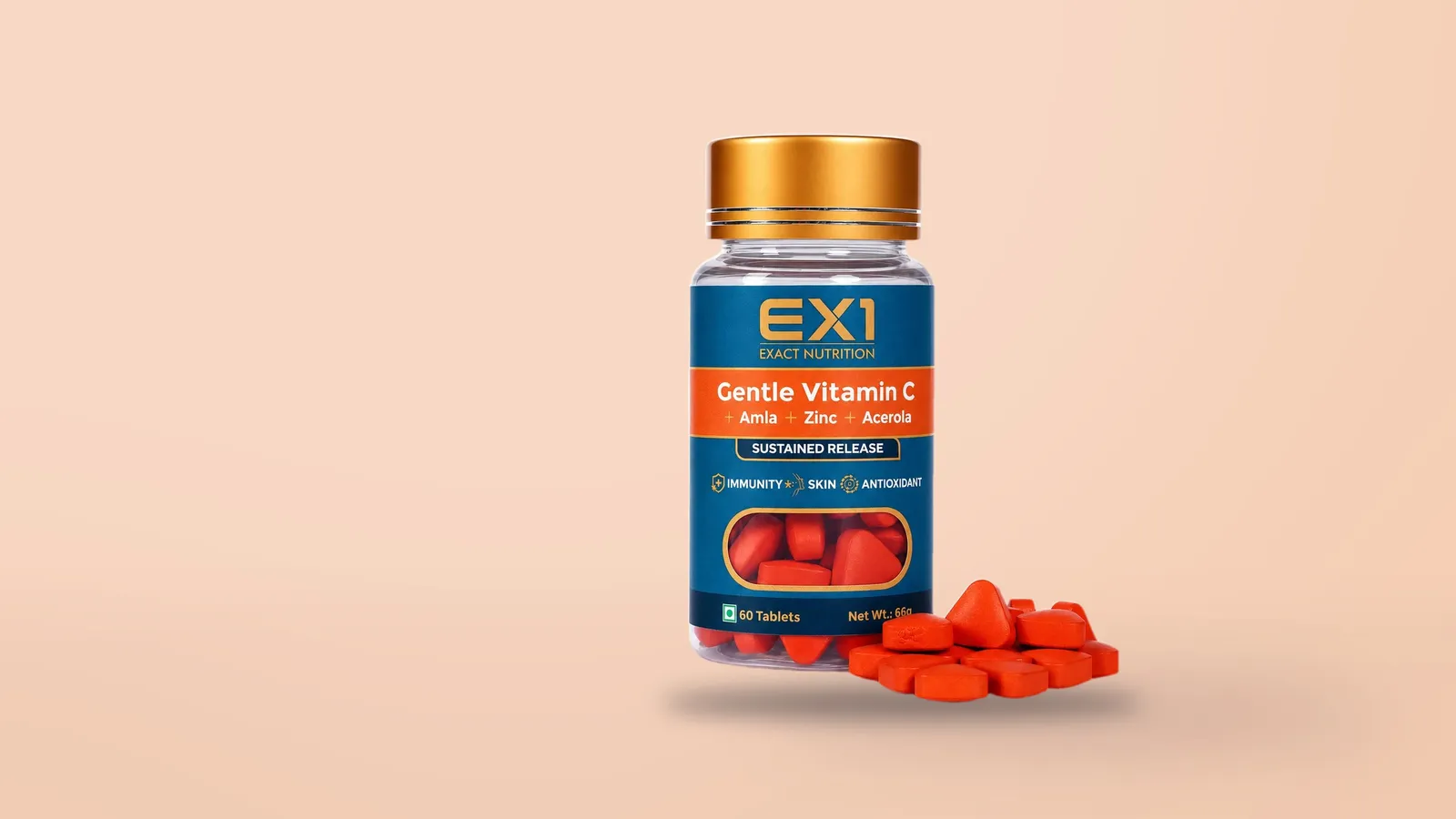
EX1 Gentle Vitamin C gives 80 mg of vitamin C, 17 mg of zinc (as gluconate) and 500 mg of amla extract in one tablet a day. That is the full ICMR-NIN 2020 RDA for men for both nutrients, and about 123% of the women's vitamin C figure. The vitamin C comes from ascorbic acid and acerola extract. The amla extract's own vitamin C is not counted in the 80 mg.
Vitamin C contributes to normal immune function, normal collagen formation and the protection of cells from oxidative stress. Zinc contributes to normal immune function.
No trial has tested this combination of vitamin C, zinc and amla, so each ingredient is described on its own evidence. EX1 says one tablet daily with or after food, best with breakfast. Not for children.
Frequently asked questions
Is 80 mg of vitamin C enough?
For most adults, 80 mg meets or exceeds the RDA: ICMR-NIN (2020) sets 80 mg for men and 65 mg for women. A 2017 Nutrients review suggests 100 to 200 mg a day from all sources for everyday immune defence, so keep eating fruit, vegetables or amla alongside an 80 mg supplement.
Is it safe to take vitamin C every day?
Daily vitamin C near the RDA sits far below the upper limit. The MSD Manual gives an upper limit of 2,000 mg a day, and 80 mg is 4% of it. Large US studies linked 1,000 mg or more a day in men to a modestly higher kidney stone risk.
Should I take vitamin C tablets before or after food?
EX1 says one tablet daily with or after food, best with breakfast. Vitamin C is water-soluble and not stored for long, so take it at the same time each day.
Does vitamin C help with dark circles?
We found no study showing that oral vitamin C tablets change dark circles. A 2017 Nutrients review calls the value of vitamin C supplements for skin, over simply eating enough, poorly understood. Dark circles have several possible causes, so ask a dermatologist.
Do vitamin C tablets help hair?
We found no study showing that vitamin C tablets change hair growth or hair fall. Vitamin C contributes to normal collagen formation, a claim about skin and connective tissue, not hair. If you are losing more hair than usual, see a doctor or dermatologist.
Can I take vitamin C and zinc together?
Yes. Vitamin C and zinc both contribute to normal immune function, and many vitamin C zinc tablets combine them. ICMR-NIN (2020) sets zinc at 17 mg a day for men and 13 mg for women. Count the zinc in every product you take, including a multivitamin.
Vitamin C tablet kab lena chahiye, aur roz kitna lena chahiye?
EX1 kehta hai: roz ek tablet, khane ke saath ya khane ke baad, best hai breakfast ke saath. ICMR-NIN (2020) ke hisaab se adult men ko roz 80 mg aur adult women ko 65 mg vitamin C chahiye. Yeh khane aur supplement, dono milakar hai.
Vitamin C tablet ke fayde kya hain?
Vitamin C normal immune function, normal collagen formation aur cells ko oxidative stress se protection mein contribute karta hai. Zinc bhi normal immune function mein contribute karta hai. Zyada dose ka matlab zyada fayda nahi: ek study mein immune cells 100 mg roz par hi full ho gaye the.
Sources
- ICMR-NIN, 2020: Nutrient Requirements for Indians, the RDA and EAR for vitamin C and zinc for adult men and women.
- PNAS, 1996: inpatient study of seven healthy volunteers; immune cells full at 100 mg a day, plasma saturated at 1,000 mg, absorption falling at single doses of 500 mg and above.
- Nutrients, 2017: review of vitamin C and immune function; vitamin C builds up in white blood cells, and 100 to 200 mg a day from all sources is suggested for everyday immune defence.
- Cochrane Database of Systematic Reviews, 2013: review of vitamin C and colds; no reduction in how often people caught colds in the general community, shorter colds at 200 mg a day or more.
- Cochrane Database of Systematic Reviews, 2024: review of zinc and colds across 34 studies; low-certainty evidence on cold duration, little or no difference to catching a cold.
- JRSM Open, 2017: meta-analysis of seven zinc lozenge trials at 80 to 207 mg a day, colds about a third shorter.
- Nutrients, 2017: review of zinc and the immune system; zinc is essential for immune function.
- Nutrients, 2017: review of vitamin C and skin; vitamin C as a co-factor for collagen enzymes, skin levels tracking blood supply.
- American Journal of Kidney Diseases, 2016: US cohort analysis linking supplemental vitamin C at 1,000 mg a day or more to modestly higher kidney stone risk in men.
- MSD Manual Professional Edition, 2026: vitamin C upper limit of 2,000 mg a day and effects of high intake.
- PLoS ONE, 2011: population survey of low vitamin C in adults aged 60 and over in north and south India.
- Frontiers in Pharmacology, 2023: review of amla's composition, including vitamin C content of the fresh fruit.
- Contemporary Clinical Trials Communications, 2020: 18-week crossover trial of 500 mg amla a day in 15 healthy adults.