Iron Tablets for Women: Hair Fall, Chai, Vitamin C and Timing
By Ayush Goyal, Founder, EX1
What the research says about iron tablets for women: how chai and vitamin C change absorption, what low iron has to do with hair fall, when to take your tablet, and why a blood test comes first.
Iron tablets for women supply iron, the mineral the body uses to make haemoglobin and red blood cells and to carry oxygen. They come up so often in India because 57% of Indian women aged 15 to 49 were anaemic in NFHS-5 (2019-21), and low iron is one of the causes.
How much a tablet does for you depends on what you eat and drink with it, when you take it and the form of iron inside. But start with a blood test. It tells you whether iron is your problem at all.
Iron tablets for women: why are they recommended so often in India?
Iron tablets for women are often recommended in India because anaemia is common. According to NFHS-5 (2019-21), 57% of Indian women aged 15 to 49 are anaemic. Anaemia has several causes, and low iron is one of them. ICMR-NIN (2020) sets the iron RDA for adult Indian women at 29 mg a day.
Anaemia means your blood carries less haemoglobin than your body needs. The NFHS-5 figure is up from 53.1% in NFHS-4 (2015-16).
It does not mean 57% of women are low in iron, or that every woman needs an iron tablet. Anaemia can also come from other nutrient gaps and blood loss.
For adult men, the ICMR-NIN RDA is 19 mg a day. Women lose iron every month through periods.
What are iron tablets, and what do they do?
Iron tablets are supplements that supply iron bound to a carrier, such as ferrous sulphate, ferrous fumarate or ferrous bisglycinate. Iron contributes to normal formation of red blood cells and haemoglobin, to normal oxygen transport, and to the reduction of tiredness and fatigue. A good label states the elemental iron.
Elemental iron is the iron itself, not the weight of the compound it is bound to. We explain the same label trap in elemental dose versus salt weight.
Dal, rajma, chana, leafy greens and iron tablets all carry non-haem iron. Your body takes it up less readily than the haem iron in meat and fish. On a vegetarian plate, what sits next to the dal matters.
Iron deficiency symptoms: what are the signs of low iron?
Iron deficiency symptoms often start with tiredness that sleep does not fix. Pale skin, breathlessness on exertion and brittle nails are other signs. Low iron stores can exist even when haemoglobin is normal. A ferritin test, a marker of iron stores, checks this.
Ferritin is the protein that stores iron; its blood level marks your iron reserve. A 2012 trial in CMAJ enrolled 198 menstruating women with unexplained tiredness, low iron stores and normal haemoglobin. Those given 80 mg of iron a day for 12 weeks saw fatigue scores fall by 47.7%. Those on placebo saw a fall of 28.8%.
That was a prescription-strength dose. The result is about that dose. None of these signs is specific to iron. Poor sleep and other nutrient gaps can feel much the same.
How to increase hemoglobin: what actually helps?
How to increase hemoglobin starts with a blood test, because low haemoglobin has more than one cause. If low iron is the cause, the usual steps are iron-rich foods eaten with vitamin C, chai kept away from those meals, and the iron your doctor advises. Vitamin C increases iron absorption; tea with a meal reduces it.
Haemoglobin is the iron-containing protein in red blood cells that carries oxygen. WHO updated its haemoglobin cut-offs for anaemia in a 2024 guideline, current as of October 2026. For non-pregnant women aged 15 to 65, the guideline's cut-off is a haemoglobin below 120 g/L, which is 12 g/dL. A blood test (haemoglobin, and often ferritin) tells you where you stand. Most of us first see haemoglobin as the Hb line on a CBC report. Ask your doctor which tests suit you.
On an Indian plate: pair dal, rajma or palak with amla, guava, lemon or tomato, and drink chai between meals, not with them.
Do iron tablets help with hair fall?
Low iron is linked to hair fall in women, but iron tablets have not been shown to regrow hair. A 2022 review of 36 studies found that women with non-scarring hair loss tended to have lower ferritin, a marker of iron stores. These were observational studies, and they tested no supplements.
Non-scarring hair loss is thinning or shedding where the follicles stay intact, what most women mean by hair fall. A 2022 review of 36 studies and 10,029 women found that women with non-scarring hair loss tended to have lower ferritin than women without it. Anaemia itself was not more common among them.
A 2010 review in the Journal of the American Academy of Dermatology said the link between low iron and hair loss in women is still debated. It found no randomised, controlled trials of iron for this kind of hair loss.
Our read: more hair on the comb is a reason to get tested before you blame iron. Hair concerns in PCOS have their own evidence, covered in myo-inositol for PCOS.
Does chai or coffee block iron absorption?
Chai can sharply cut the iron you absorb from a meal. In a study of young Indian women published in the American Journal of Clinical Nutrition (2008), one or two cups of black tea drunk with a rice meal cut iron absorption from that meal by 49% to 67%. Keep chai away from your iron tablet and iron-rich meals.
The study tested black tea with rice meals. Ten women with iron-deficiency anaemia and ten with normal iron took part. In the women with normal iron, one cup of tea cut absorption by 49% and two cups by 66%. In the women with iron-deficiency anaemia, the drops were 59% and 67%.
It tested a meal, with no supplement and no time gap, so it gives no number of hours to wait. Milky 4 pm chai and coffee were not tested. Both usually get the same advice.
Chai and vitamin C vs iron absorbed from a rice meal
Black tea with the meal (change in iron absorbed)
Normal iron: 1 cup-49%- Normal iron: 2 cups-66%
- Iron-deficiency anaemia: 1 cup-59%
- Iron-deficiency anaemia: 2 cups-67%
Vitamin C added to the meal (change in iron absorbed)
Normal iron: vitamin C at 2:1 to iron+270%- Normal iron: vitamin C at 4:1 to iron+343%
- Iron-deficiency anaemia: vitamin C at 2:1+291%
- Iron-deficiency anaemia: vitamin C at 4:1+350%
Source: American Journal of Clinical Nutrition, 2008
Meal study, 10 women per group. Vitamin C ratios counted by molecules.
Should you take iron tablets with vitamin C?
Taking iron with vitamin C helps, because vitamin C increases iron absorption. In a study of young Indian women, adding vitamin C to a rice meal at a 2:1 or 4:1 ratio to iron, counted by molecules, increased iron absorption by 270% to 350%.
Vitamin C (ascorbic acid) helps the body take up non-haem iron, the kind in plant foods and iron tablets. The NIH Office of Dietary Supplements describes it as enhancing non-haem iron bioavailability.
Most iron tablets carry less vitamin C than those ratios, so the figures describe that meal, not a supplement. Our post on how much vitamin C a day covers the dose.
Iron tablets kab lena chahiye: what is the best time to take them?
The best time to take iron tablets is the time your label or doctor gives, kept apart from chai, coffee and calcium tablets. No study in our sources compared morning with night. Daily versus alternate-day dosing matters mainly at higher, prescribed doses.
Hepcidin is the hormone that controls how much iron your gut lets in. Research in Blood (2015) found that iron doses of 60 mg or more raised hepcidin for about a day. Absorption from the next day's dose fell by 35% to 45%. The authors suggest 40 to 80 mg doses and avoiding twice-daily dosing.
A 2017 trial in The Lancet Haematology gave iron-depleted women 60 mg of iron. On alternate days, 21.8% of the dose was absorbed. On consecutive days, 16.3% was.
Both tested 40 mg or more. On a higher-dose prescribed iron? Ask your doctor whether alternate-day dosing suits you.
According to the NIH Office of Dietary Supplements, calcium might interfere with iron absorption, although this has not been definitively established. The easy precaution is to take your calcium tablet at a different time of day.
Ferrous bisglycinate vs ferrous sulphate: which is easier on the stomach?
Ferrous bisglycinate is iron bound to the amino acid glycine; ferrous sulphate is the older, common iron salt. A 2015 review of 43 trials found ferrous sulphate roughly doubled the odds of stomach side effects compared with placebo. Head-to-head evidence for ferrous bisglycinate is thinner and comes mostly from pregnant women on low doses.
Ferrous bisglycinate is also sold as iron bisglycinate. The 2015 review, in PLoS ONE, covered 6,831 adults, and its odds ratio was 2.32.
In a 2024 study of pregnant women taking low-dose iron, published in the Journal of Pregnancy, those on 25 mg of ferrous bisglycinate reported fewer stomach complaints than those on 40 mg of ferrous fumarate or 50 mg of ferrous sulphate. The comparison groups also took more iron, so dose and form are tangled together.
A 2023 review in Nutrition Reviews pooled randomised trials of ferrous bisglycinate against other iron supplements. In pregnant women (9 trials) it was associated with higher haemoglobin and with fewer reported stomach side effects (incidence rate ratio 0.36, 95% CI 0.17 to 0.76); in children (4 trials) it found no significant difference in haemoglobin. The review's authors called for more trials. The paper states that they declare no relevant interests. A bisglycinate maker later announced a follow-up trial with the same research group.
| Study (journal, year) | Compared | Finding | Limit |
|---|---|---|---|
| PLoS ONE, 2015 | Ferrous sulphate vs placebo, 43 trials | Odds ratio 2.32 for stomach side effects | Says nothing about bisglycinate |
| Journal of Pregnancy, 2024 | Pregnant women: 25 mg bisglycinate vs 40 mg fumarate or 50 mg sulphate | Fewer stomach complaints on bisglycinate | Other groups took more iron |
| Nutrition Reviews, 2023 | Ferrous bisglycinate vs other iron supplements, 17 trials (9 in pregnant women) | Higher haemoglobin and fewer reported stomach side effects in pregnant women | Pregnant women only; a bisglycinate maker later announced a follow-up trial with the same research group |
Any form of iron can upset the stomach or cause constipation. See also why nutrient form matters in a multivitamin.
Who should not take iron tablets without a doctor's advice?
Iron tablets need a doctor's advice first if you are pregnant or breastfeeding, have haemochromatosis or another iron-overload condition, take thyroid medicine, levodopa or acid-reducing medicines, or already take another product with iron. Keep iron out of children's reach: accidental iron overdose is a leading cause of fatal poisoning in children under 6.
More iron is not better iron. The NIH Office of Dietary Supplements notes:
- The US upper limit for iron in adults is 45 mg a day from diet and supplements combined, set on stomach side effects.
- People with haemochromatosis are advised to avoid iron and vitamin C supplements.
- Levothyroxine labels advise not taking it within 4 hours of iron.
- Iron can interact with levodopa and with proton pump inhibitors (acid-reducing medicines).
Consult a physician before use if pregnant, lactating, on medication or with a medical condition. Not to be used by children.
How EX1 fits
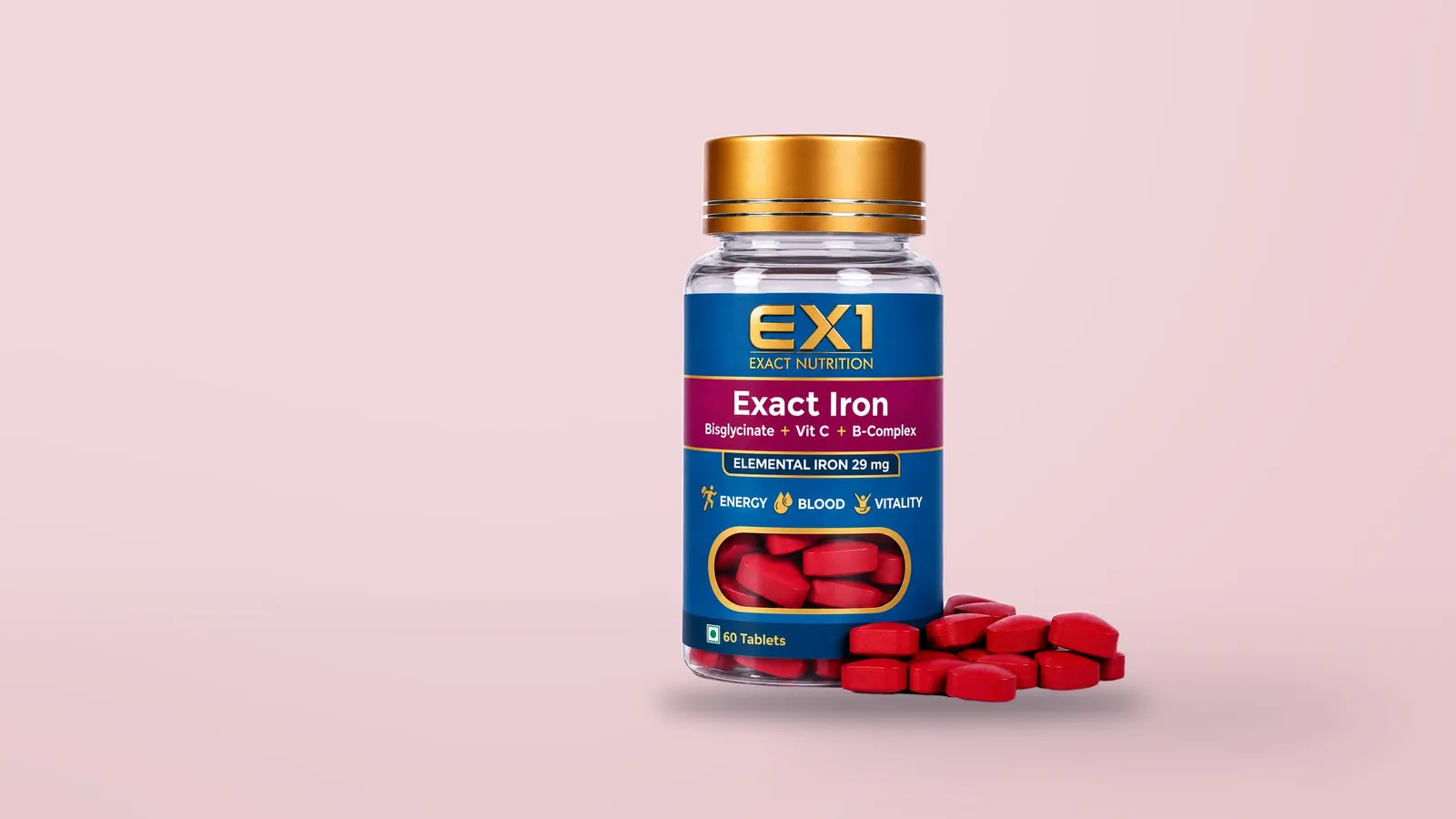
EX1 Iron (Ferrous Bisglycinate) gives 29 mg of elemental iron per tablet, from 145 mg of ferrous bisglycinate. Each tablet also carries 65 mg vitamin C, 129.41 mcg folate as folic acid, 2.2 mcg vitamin B12 as cyanocobalamin, and 1.9 mg vitamin B6 as pyridoxine HCl. Take one tablet a day with or after food; a bottle holds 60.
Iron contributes to normal formation of red blood cells and haemoglobin, to normal oxygen transport, and to the reduction of tiredness and fatigue. Vitamin C increases iron absorption.
No trial in our sources tested this combination in one tablet. The studies above describe their own doses and forms, not this product. It is a daily supplement, not a replacement for iron your doctor has prescribed. Do not take it alongside another iron product or a multivitamin with iron unless your doctor agrees.
ICMR-NIN (2020) sets the iron RDA for adult Indian women at 29 mg a day, and EX1's tablet contains 29 mg of elemental iron.
Frequently asked questions
Iron tablet khane se pehle lena chahiye ya baad mein?
Follow your tablet's label or your doctor. With or after food is a common label direction, and food can make a tablet sit easier on the stomach. Either way, keep chai away from it. In a study of young Indian women, tea drunk with a meal cut iron absorption sharply.
Can I take iron tablets at night?
Yes, if your label or doctor allows it. No study in our sources compared night with morning dosing. What matters more is keeping the tablet apart from chai, coffee, calcium tablets and thyroid medicine; levothyroxine labels advise a 4-hour gap from iron.
How long after an iron tablet can I drink chai?
No study in our sources set a gap. The Indian study behind this advice tested tea drunk with a rice meal, where one or two cups cut iron absorption by 49% to 67%. Tea taken hours after a tablet was never tested. So drink chai between meals, and apart from your tablet.
Can I take iron tablets after delivery?
Consult a physician before use if pregnant, lactating, on medication or with a medical condition. After delivery, your doctor may already have you on prescribed iron. Agree any extra iron product with them first.
What are the side effects of iron tablets?
Stomach upset and constipation are the common ones. A 2015 review in PLoS ONE of 43 trials found ferrous sulphate roughly doubled the odds of stomach side effects compared with placebo. Keep iron out of children's reach: accidental overdose is a leading cause of fatal poisoning in children under 6.
How long do iron tablets take to work?
Weeks. In the 2012 CMAJ trial of tired women with low iron stores, fatigue was measured over 12 weeks, and the authors suggested checking blood markers after six weeks. A repeat blood test, timed by your doctor, is the fair way to judge progress.
How can I increase hemoglobin fast?
Start with a blood test, because low haemoglobin has more than one cause. If low iron is the cause, the usual steps are iron-rich foods eaten with vitamin C, chai kept away from those meals, and the iron your doctor advises. Vitamin C increases iron absorption; tea with a meal reduces it. Expect weeks, not days: in the 2012 CMAJ trial of tired women with low iron stores, fatigue was measured over 12 weeks, and the authors suggested checking blood markers after six weeks.
What is a normal haemoglobin level for women?
WHO's 2024 guideline sets the anaemia cut-off for non-pregnant women aged 15 to 65 at a haemoglobin below 120 g/L, which is 12 g/dL. A doctor reads that number alongside other tests, often ferritin, so ask which tests suit you.
Sources
- NFHS-5 (Ministry of Health and Family Welfare, Lok Sabha reply, 2023): 57.0% of women aged 15 to 49 anaemic in NFHS-5 (2019-21), up from 53.1% in NFHS-4 (2015-16).
- ICMR-NIN, 2020: iron RDA of 29 mg a day for adult Indian women and 19 mg a day for adult men.
- American Journal of Clinical Nutrition, 2008: young Indian women; one or two cups of black tea with a rice meal cut iron absorption by 49% to 67%; vitamin C at 2:1 or 4:1 to iron raised it by 270% to 350%.
- NIH Office of Dietary Supplements, Iron Fact Sheet for Health Professionals (updated 2025): vitamin C enhances non-haem iron bioavailability; adult upper limit 45 mg a day; overdose risk in children under 6; haemochromatosis, levothyroxine, levodopa and proton pump inhibitor cautions; calcium might interfere with iron absorption.
- PLoS ONE, 2015: review of 43 trials and 6,831 adults; ferrous sulphate raised the odds of stomach side effects against placebo (odds ratio 2.32).
- Journal of Pregnancy, 2024: pregnant women on 25 mg ferrous bisglycinate reported fewer stomach complaints than those on 40 mg ferrous fumarate or 50 mg ferrous sulphate.
- Blood, 2015: iron doses of 60 mg or more raised hepcidin for about a day and cut next-day absorption by 35% to 45%.
- The Lancet Haematology, 2017: alternate-day 60 mg iron gave higher fractional absorption than daily dosing (21.8% vs 16.3%).
- CMAJ, 2012: 198 menstruating women with unexplained tiredness, low iron stores and normal haemoglobin; 80 mg iron a day for 12 weeks cut fatigue scores by 47.7%, against 28.8% on placebo.
- Skin Appendage Disorders, 2022: review of 36 observational studies and 10,029 women; lower ferritin in women with non-scarring hair loss; anaemia not more common.
- Journal of the American Academy of Dermatology, 2010: the low-iron and hair-loss link in women is debated; no randomised, controlled trials of iron for it.
- WHO, 2024: guideline on haemoglobin cut-offs to define anaemia; below 120 g/L for non-pregnant women aged 15 to 65.
- Nutrition Reviews, 2023: systematic review and meta-analysis of 17 randomised trials of ferrous bisglycinate against other iron supplements; higher haemoglobin and fewer reported stomach side effects in pregnant women (9 trials), no significant haemoglobin difference in children (4 trials).