Ashwagandha Benefits for Men and Women, and When to Take It
By Ayush Goyal, Founder, EX1
What randomised trials report on ashwagandha for stress, sleep and training in men and women, how the trials dosed it, the side effects, and who should not take it.
Ashwagandha benefits in human trials centre on stress. Two meta-analyses of randomised trials link ashwagandha root extract to lower cortisol. Smaller bodies of evidence report a modest improvement in sleep and, alongside training, in strength and recovery in men and women.
Most trials gave 600 mg a day as two 300 mg doses and measured results at eight weeks or more. Cases of liver injury have been reported, and ashwagandha is not recommended in pregnancy or while breastfeeding.
Ashwagandha benefits: what does the research show?
Ashwagandha benefits in randomised trials are clearest for cortisol, which fell more than with placebo in two meta-analyses. Self-rated stress improved in one meta-analysis but not in the other. A 2021 meta-analysis found a small improvement in overall sleep, and another found better strength and recovery measures in healthy adults.
Ashwagandha (Withania somnifera) is an Ayurvedic herb whose root is used as a Rasayana. In Ayurveda, it is traditionally used to help the body adapt to everyday stress and support vitality. Modern trials test standardised root extract against placebo.
| What was measured | What trials reported | Who was studied | Source |
|---|---|---|---|
| Serum cortisol | Lower than placebo | 9 randomised trials, 558 participants | Explore, 2024 |
| Serum cortisol | Lower than placebo | Trials with 488 participants in total | Nutrition and Health, 2025 |
| Self-rated stress | Lower in one analysis, no significant effect in the other | Same two analyses | Explore, 2024; Nutrition and Health, 2025 |
| Overall sleep | A small but significant improvement | 5 randomised trials, 400 adults | PLoS One, 2021 |
| Strength, power and recovery | Better than placebo | 12 trials in healthy men and women | Journal of Functional Morphology and Kinesiology, 2021 |
| Testosterone | A larger measured rise than placebo | Two single trials, in men only | Journal of the International Society of Sports Nutrition, 2015; American Journal of Men's Health, 2019 |
Our read: cortisol is the result to lean on.
Does ashwagandha help with stress and cortisol?
Ashwagandha has its strongest evidence on cortisol. A 2024 meta-analysis in Explore pooled nine randomised trials with 558 participants and linked ashwagandha to lower perceived-stress scores, lower anxiety-scale scores and lower serum cortisol than placebo. A 2025 meta-analysis in Nutrition and Health confirmed the cortisol fall but found no significant effect on perceived stress.
Cortisol is the hormone the body releases in response to stress, and it can be measured in blood. That makes it a harder outcome than a questionnaire score. Doses and formulations varied across the trials both reviews pooled.
The best-known trial was run here in India. In a 60-day study published in the Indian Journal of Psychological Medicine in 2012, 64 adults with a history of chronic stress took 300 mg of root extract twice a day. Stress-scale scores fell by 44% with ashwagandha, against 5.5% with placebo. Serum cortisol fell by 27.9%, against 7.9%. Side effects were mild and similar in both groups.
Swap the extract or the dose and results shift. A 2019 trial in Medicine used a different extract at 240 mg once a day for 60 days. It reported lower anxiety-scale scores and lower morning cortisol than placebo, but only a near-significant change on a combined stress scale.
Does ashwagandha help you sleep?
Ashwagandha has a small, measurable sleep effect in trials. A 2021 PLoS One meta-analysis of five randomised trials, covering 400 adults, found a small but significant improvement in overall sleep. The effect was clearer in the subgroup of adults with insomnia in those studies, at 600 mg a day or more, and over eight weeks or more.
Ashwagandha is not a sedative. The trials gave it daily for weeks, and the review found the clearer effect at the higher dose and the longer course. Our read: the sleep evidence is real but small. If you need to be asleep by eleven tonight, this is the wrong tool.
A 2021 trial in the Journal of Ethnopharmacology followed 80 adults, half healthy and half with insomnia, for 8 weeks. Time to fall asleep, sleep efficiency and total sleep time all improved more than with placebo, with the larger change in the insomnia group.
The individual trials are in ashwagandha for sleep: what the evidence shows. If you are weighing magnesium too, see magnesium glycinate for sleep.
Ashwagandha benefits for men: what the studies measured
Ashwagandha has been tested in two trials in men that measured testosterone. In 57 men new to resistance training, 300 mg of root extract twice a day for eight weeks was linked to larger strength gains and a larger rise in testosterone than placebo. In older overweight men, a different extract raised testosterone but did not change fatigue or vigour.
Testosterone was measured in these trials as a lab value, not as a felt benefit.
The 2015 trial, in the Journal of the International Society of Sports Nutrition, followed 57 men aged 18 to 50 for eight weeks of resistance training. Bench-press and leg-extension gains were larger than with placebo, and so was the measured rise in testosterone. The authors also reported less exercise-induced muscle damage.
The 2019 trial, in the American Journal of Men's Health, was a 16-week crossover in 57 overweight men aged 40 to 70 with mild fatigue. DHEA-S rose 18% more than with placebo. Testosterone rose 14.7% more. There was no difference in fatigue or vigour.
Two single trials make a thin base. The strength meta-analysis below is wider and pooled men and women.
Ashwagandha benefits for women: what has been studied
Ashwagandha benefits for women rest on the evidence in adults covered above. The stress and sleep trials were run in adults, and the 2021 strength meta-analysis pooled men and women. Only the two testosterone trials were limited to men. Ashwagandha is not recommended in pregnancy or while breastfeeding.
The cortisol, sleep and strength findings in this guide come from adult and mixed-sex trials. This guide does not draw on women-only trials.
France's food-safety agency (2024) advised people with hormone conditions to avoid ashwagandha.
Does ashwagandha help with strength and recovery?
Ashwagandha was linked to better strength and recovery in a 2021 meta-analysis in the Journal of Functional Morphology and Kinesiology. It pooled 12 trials in healthy adults, men and women, and found ashwagandha outperformed placebo on strength and power measures and on recovery measures. Doses ranged from 120 to 1,250 mg a day.
In that analysis, recovery was measured alongside fatigue after exercise. The authors called for more training studies.
The lead author was employed by a company that sells an ashwagandha product. Weigh the result with that in mind.
For ashwagandha with creatine, the evidence is in creatine and ashwagandha: what the research says.
Best time to take ashwagandha: morning or night, once or twice a day?
Ashwagandha trials mostly gave 600 mg a day as two 300 mg doses. One used a single daily dose of a different extract. No trial we found compared morning with evening dosing, and effects were measured at eight weeks or more. Taking it at the same time each day, with food, is the simplest routine.
A split dose means the daily amount is taken in two parts across the day.
| Trial | Daily dose | How it was taken | Duration |
|---|---|---|---|
| Indian Journal of Psychological Medicine, 2012 | 600 mg | 300 mg twice a day | 60 days |
| Journal of the International Society of Sports Nutrition, 2015 | 600 mg | 300 mg twice a day | 8 weeks |
| Journal of Alternative and Complementary Medicine, 2017 | 600 mg | Split not stated | 8 weeks |
| Medicine, 2019 (different extract) | 240 mg | Once a day | 60 days |
The EX1 label directs one capsule a day. That is the same 600 mg daily total as the trials above, taken once instead of split. The trials we reviewed did not test one 600 mg dose against two 300 mg doses, so we cannot tell you the two schedules perform the same.
After breakfast, with your morning chai, is an easy slot to keep.
How the trials dosed ashwagandha (bar = daily mg, segments = doses)
- 300 mg + 300 mg, 60 days, 64 adults with chronic stress600 mg a day
Indian Journal of Psychological Medicine, 2012
- 300 mg + 300 mg, 8 weeks, 57 men in resistance training600 mg a day
No morning or night labels.
Journal of the International Society of Sports Nutrition, 2015
- 600 mg a day, schedule not stated, 8 weeks, 50 adults600 mg a day
Journal of Alternative and Complementary Medicine, 2017
- 240 mg once a day, 60 days, a different extract240 mg a day
Medicine, 2019
- EX1: 600 mg in one capsule, once a day600 mg a day
EX1 label
Clearer sleep effects at 600 mg a day or more, over 8 weeks or more (PLoS One, 2021).
Ashwagandha side effects: is it safe to take daily?
Ashwagandha side effects in trials were mostly mild: stomach upset, loose stools, headache, drowsiness and nausea. Most trials ran 8 to 12 weeks, so long-term safety data are limited. Cases of liver injury have been reported with ashwagandha-containing supplements, so know the warning signs before you start.
Drowsiness is a reported side effect, even though ashwagandha is not a sedative.
Cases of liver injury have been reported with ashwagandha-containing supplements. A 2020 case series in Liver International described five people who developed jaundice 2 to 12 weeks after starting. They also had nausea, tiredness, itching and abdominal discomfort. None had liver failure. In four of the five, liver tests returned to normal within 1 to 5 months. The Merck Manual (2025) also notes that liver injury may occur.
Stop taking ashwagandha and see a doctor if you notice yellowing of the skin or eyes, dark urine, persistent itching, nausea or unusual tiredness.
Ashwagandha can also move thyroid hormone levels. If you have a thyroid condition, read the last question below first.
Who should not take ashwagandha?
Ashwagandha is not recommended in pregnancy or while breastfeeding. Under-18s, people with hormone-sensitive, liver or heart conditions, and anyone on medicines for thyroid, sleep or sedation, immune suppression, blood glucose or blood pressure should avoid it or check with a doctor first.
Ashwagandha can interact with medicines and can shift hormone levels.
- Not for use during pregnancy or breastfeeding.
- Under 18: only with a paediatrician's supervision.
- Medicines for thyroid, sleep or sedation, immune suppression, blood glucose, or blood pressure: ashwagandha can interact with them. Check with your doctor first.
- Hormone-sensitive conditions, including prostate conditions: ashwagandha may raise testosterone, so avoid it unless your doctor advises otherwise.
- Any diagnosed condition or prescription medicine: check with your physician before adding any supplement.
Some regulators have restricted ashwagandha supplements. Denmark banned it in food supplements in 2023, after a 2020 national assessment could not set a safe lower intake level. France's food-safety agency (2024) advised pregnant or breastfeeding women, under-18s, and people with hormone, liver or heart conditions to avoid it. As of October 2026, India's Ministry of Ayush has advised against leaf use, and FSSAI permits only the root and root extract in health supplements.
How to choose an ashwagandha: root extract, withanolides and dose
Ashwagandha trials at 600 mg a day used standardised root extract. The withanolide percentage on the label, whatever the brand name, is what ties a product to that studied material. Look for root extract rather than leaf, a stated withanolide percentage, and the milligrams of extract per serving.
Withanolides are the compounds ashwagandha extracts are standardised to.
The 600 mg trials used root extract, and India allows only the root and root extract in health supplements. If a label does not name the plant part, you are guessing.
The full label walkthrough is in how to read an ashwagandha label.
How EX1 fits
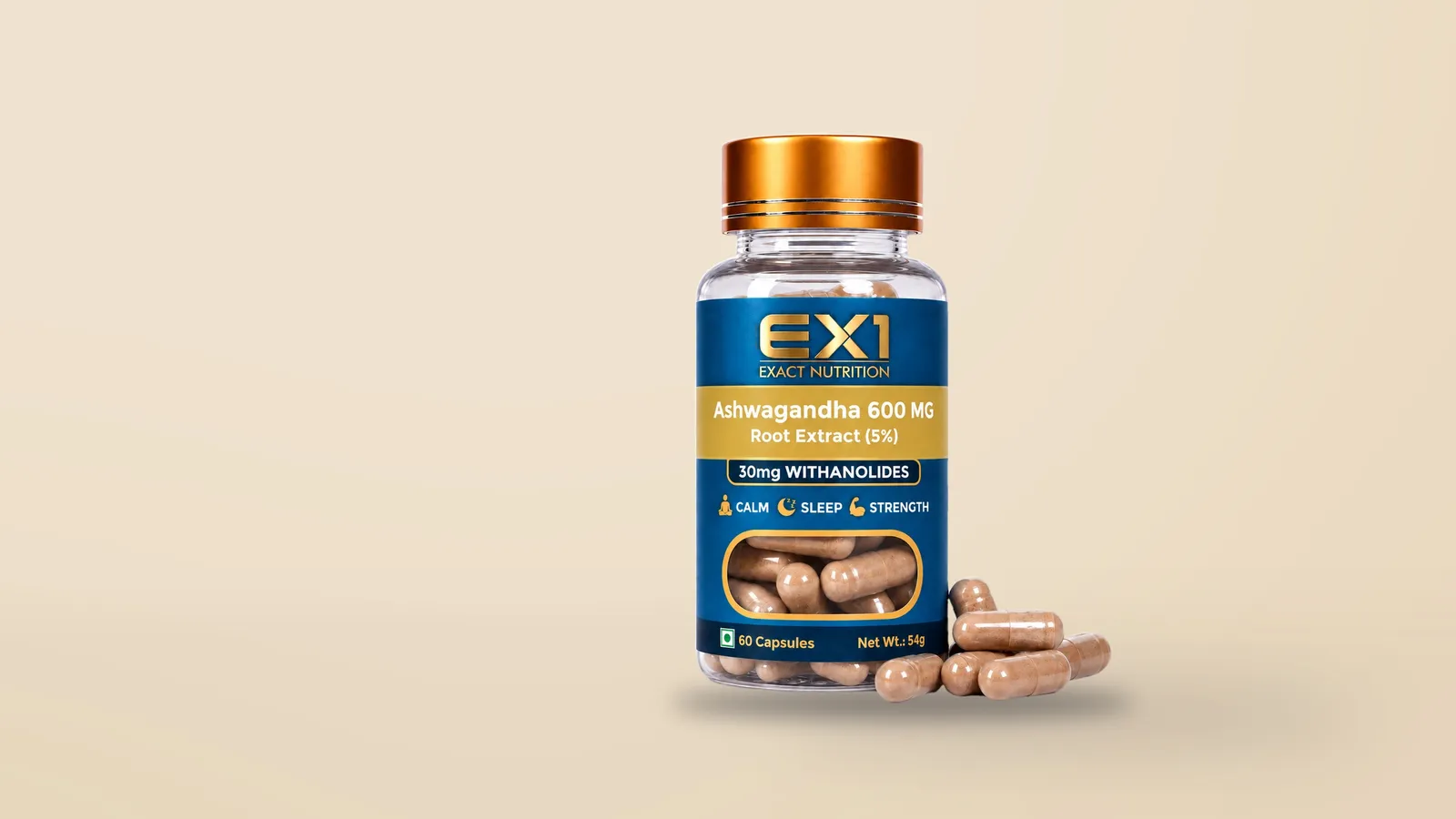
EX1 Ashwagandha is 600 mg of root extract standardised to 5% withanolides, which is 30 mg, in one vegetarian capsule a day. It is root only. Its 600 mg daily total matches the daily total used in the 2012 stress trial and the 2015 training trial, taken once a day rather than split into two doses.
EX1 Ashwagandha is an Ayurvedic proprietary medicine. Its claim of record is the traditional one: traditionally used as a Rasayana to help the body adapt to everyday stress and support vitality.
Frequently asked questions
Ashwagandha kab lena chahiye, subah ya shaam?
Subah ya shaam, dono chal sakte hain. Trials mein 600 mg ki daily dose aksar 300 mg ki do khuraak mein di gayi, aur jo trials humne dekhe unmein kisi ne subah aur raat ko compare nahi kiya. Roz ek hi samay par, khane ke saath ya khane ke baad lena, consistency ke liye sabse aasaan hai. Trials ne asar 8 hafte ya usse zyada ke baad naapa.
How long does ashwagandha take to work?
The trials measured ashwagandha's effects after eight weeks or more of daily use, not after single doses. The 2012 stress trial ran for 60 days, and the 2021 PLoS One sleep review found clearer effects over eight weeks or longer. Give it about two months of daily use before you judge it.
Can I take ashwagandha every day, and for how long?
The trials gave ashwagandha every day, and most ran for 8 to 12 weeks, with mostly mild side effects. Long-term safety data are limited, so there is no trial-backed answer for use over many months. If you plan to take it longer than the trials did, review it with your doctor.
Can I take ashwagandha with magnesium glycinate or shilajit?
We found no published trial of ashwagandha taken with magnesium glycinate or with shilajit, so any benefit of either pair is inferred from separate evidence. If a product sells a combined effect, ask which trial tested that combination. If you are weighing other ingredients, our guide to L-theanine benefits covers one more, on its own evidence. Check with your doctor first if you take any prescription medicine.
Ashwagandha capsule vs powder: which is better?
No trial we found compared ashwagandha capsules with powder. The trials used standardised root extract in capsules, at a stated dose. Plain root powder is a different, unstandardised material, so trial results do not carry over to it by weight. Whatever the format, check the label for root extract and a stated withanolide percentage.
Can I take ashwagandha if I have a thyroid condition?
Check with your doctor first, and take your latest thyroid report along. In an eight-week trial in 50 adults with mildly raised TSH (Journal of Alternative and Complementary Medicine, 2017), 600 mg a day of root extract shifted TSH, T3 and T4 significantly compared with placebo. Ashwagandha can also interact with thyroid medicines.
Is ashwagandha hot in nature (garam taseer)?
In the Ayurvedic classification, ashwagandha root has an ushna potency, which means warming. That is how the Ayurvedic Pharmacopoeia of India lists it, and it is a traditional description, not a measured effect. Trials report mostly mild side effects such as stomach upset, loose stools, headache, drowsiness and nausea, and taking it with or after food is the simple step.
Sources
- Explore, 2024: meta-analysis of 9 randomised trials (558 participants); lower perceived-stress scores, anxiety-scale scores and serum cortisol with ashwagandha than placebo.
- Nutrition and Health, 2025: meta-analysis; significant fall in cortisol, no significant effect on perceived-stress scores.
- Indian Journal of Psychological Medicine, 2012: 60-day randomised trial in 64 adults with chronic stress; 300 mg root extract twice a day; lower stress scores and cortisol than placebo.
- Medicine, 2019: 60-day randomised trial of a different extract at 240 mg once a day; lower anxiety-scale scores and morning cortisol, near-significant change on a combined stress scale.
- PLoS One, 2021: meta-analysis of 5 randomised trials (400 adults); small but significant improvement in overall sleep, clearer at 600 mg a day or more and 8 weeks or more.
- Journal of the International Society of Sports Nutrition, 2015: 8-week randomised trial in 57 men new to resistance training; larger strength gains and testosterone rise than placebo.
- American Journal of Men's Health, 2019: 16-week crossover trial in 57 overweight men aged 40 to 70; greater rises in DHEA-S and testosterone, no difference in fatigue or vigour.
- Journal of Functional Morphology and Kinesiology, 2021: meta-analysis of 12 trials in healthy men and women; better strength, power and recovery measures than placebo.
- Journal of Alternative and Complementary Medicine, 2017: 8-week randomised trial in 50 adults with mildly raised TSH; 600 mg a day shifted TSH, T3 and T4.
- Liver International, 2020: case series of five people with liver injury linked to ashwagandha-containing supplements; all recovered without liver failure.
- Merck Manual Professional, 2025: ashwagandha safety review; pregnancy and breastfeeding, drug interactions, testosterone, side effects, liver injury.
- NutraIngredients, 2024 and 2026: reporting on the French food-safety agency's 2024 advice and Denmark's 2023 ban.
- SupplySide Supplement Journal, 2026: FSSAI's root-only rule for health supplements and the Ministry of Ayush leaf advisory.
- Journal of Ethnopharmacology, 2021: 80 adults, half healthy and half with insomnia, 8 weeks; time to fall asleep, sleep efficiency and total sleep time improved more than with placebo.
- Ayurvedic Pharmacopoeia of India: ashwagandha root, potency (virya) ushna.