Magnesium Glycinate Benefits: Sleep, Women and Dose
By Ayush Goyal, Founder, EX1
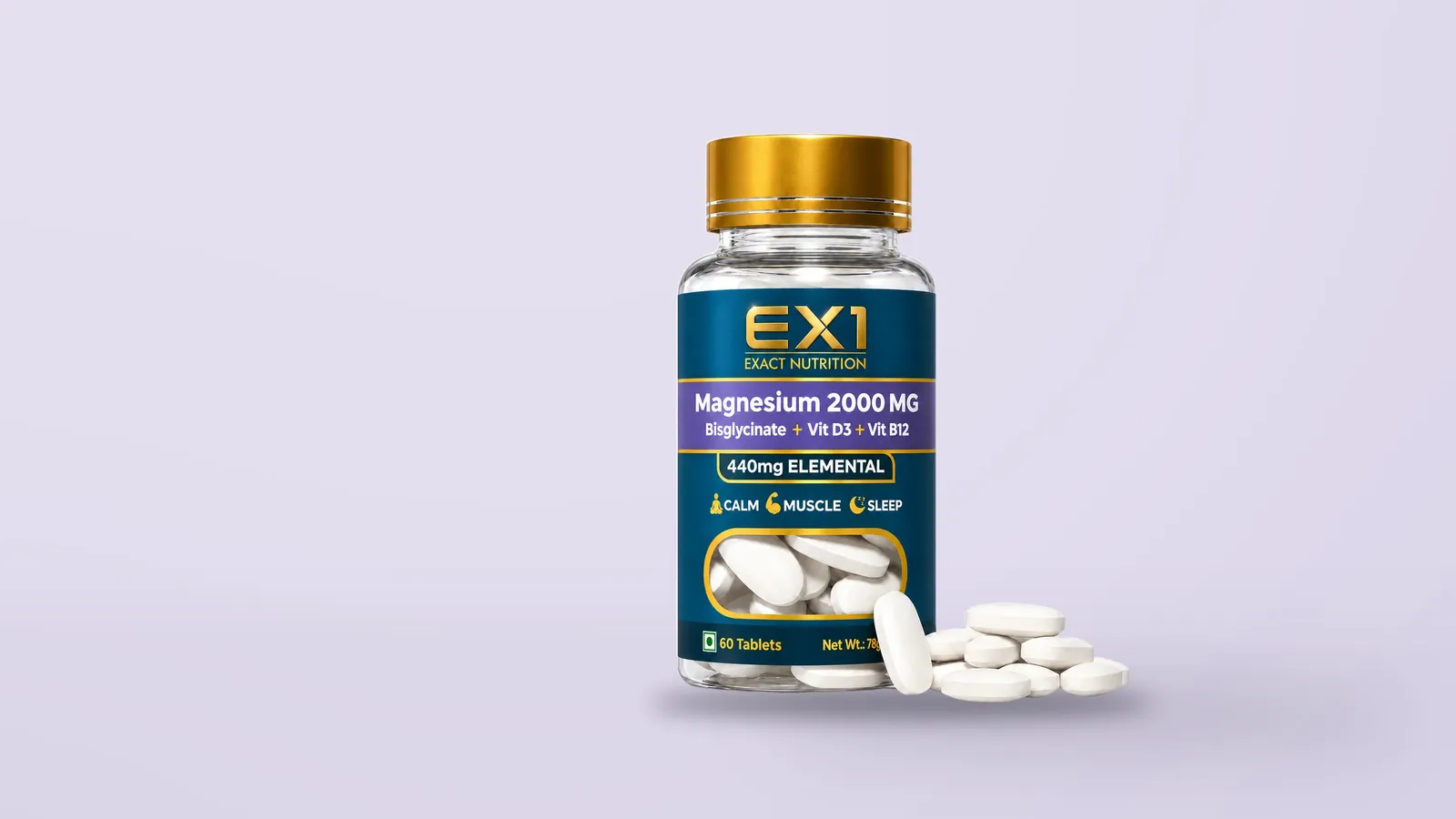
Magnesium glycinate is magnesium bound to glycine, chosen mainly for gut comfort. Here is what the trials found for sleep, stress and cramps, at what dose, and why the 350 mg upper limit matters when you start.
Magnesium glycinate is magnesium bound to the amino acid glycine, and people choose it mainly because it is gentle on the gut. Its benefits are the benefits of magnesium. The mineral contributes to normal muscle function, the normal functioning of the nervous system and the reduction of tiredness and fatigue, and a 2025 trial linked 250 mg a day to a small improvement in sleep scores.
The rest is thinner than most labels suggest. The stress studies are suggestive but poor in quality. Cramp trials found little to no difference. One number matters before you buy anything: the US upper limit for magnesium from supplements is 350 mg a day for adults.
What is magnesium glycinate, and is it the same as magnesium bisglycinate?
Magnesium glycinate and magnesium bisglycinate are two names for magnesium bound to the amino acid glycine. The 2025 sleep trial covered below uses the name bisglycinate. Whichever name a pack prints, the figure that matters is the elemental magnesium per serving, not the weight of the whole compound.
Magnesium glycinate is magnesium bound to glycine, the simplest amino acid.
Every magnesium supplement is a compound that weighs far more than the magnesium inside it, so one tablet carries two very different numbers. Our guide to how to read elemental magnesium versus salt weight shows which one to look at.
What are the benefits of magnesium glycinate?
The benefits of magnesium glycinate are the benefits of magnesium. Magnesium contributes to normal muscle function, the normal functioning of the nervous system and the reduction of tiredness and fatigue. Beyond that, a 2025 trial found a small sleep improvement at 250 mg a day, the stress evidence is suggestive but poor, and trials found little effect on cramps or weight.
A benefit claim for magnesium glycinate is a claim about magnesium. The European Food Safety Authority confirmed in 2009 that magnesium contributes to normal muscle function and to normal nerve function.
Everything else people hope for rests on less:
| What people hope for | What the research found | How strong |
|---|---|---|
| Better sleep | Insomnia Severity Index scores fell 3.9 points against 2.3 on placebo, at 250 mg a day for four weeks (Nature and Science of Sleep, 2025) | Small effect, one trial |
| Less stress | Suggestive benefit on self-reported anxiety in people prone to it (Nutrients, 2017, 18 studies) | Evidence rated poor |
| Fewer muscle cramps | Probably little to no difference to ordinary cramps (Cochrane, 2020) | Little to no effect |
| Weight loss | No significant overall change in weight, waist or body fat across 32 trials (Critical Reviews in Food Science and Nutrition, 2021) | No overall effect |
| Muscle and nerve function | Magnesium contributes to normal function of both (EFSA, 2009) | Authorised nutrient function |
In India, ICMR-NIN (2020) sets the RDA for magnesium at 440 mg a day for adult men and 370 mg a day for adult women. Your Sunday dal, whole-wheat roti, peanuts and palak all carry some. A supplement tops up that plate.
Does magnesium glycinate help you sleep?
Magnesium glycinate was linked to a small sleep improvement in one 2025 trial. In Nature and Science of Sleep, 155 adults with poor sleep took 250 mg of magnesium as bisglycinate a day for four weeks. Their Insomnia Severity Index scores fell 3.9 points against 2.3 on placebo, a small effect.
The sleep evidence for magnesium glycinate is real, and it is small. The trial was randomised and placebo-controlled, and its authors called the difference from placebo small.
The dose was 250 mg of elemental magnesium a day. The trial did not test a higher one, so it does not show that more magnesium means better sleep. Glycine itself has been studied at 3 g before bed: a very small 2012 crossover study of 7 sleep-restricted men, run by researchers at a glycine maker, found it reduced self-rated fatigue.
None of these studies compared magnesium forms, so we will not rank which is best for sleep. The longer read is magnesium for sleep: what the evidence shows.
Does magnesium glycinate help with stress and anxiety?
Magnesium glycinate has no stress trial of its own among the studies here, so the evidence is about magnesium in general. A 2017 systematic review of 18 studies in Nutrients found it suggestive of a benefit on self-reported anxiety in people prone to it, but rated the evidence as poor quality.
The stress evidence for magnesium is suggestive and unsettled. None of the studies in that review measured stress with a validated scale.
A 2018 trial in PLOS ONE gave 300 mg of magnesium a day to 264 adults, alone or with vitamin B6. Everyone in it started with high stress scores and low blood magnesium. Stress scores fell in both groups over 8 weeks. There was no placebo group, so the fall cannot be put down to magnesium alone.
We make no cortisol claim. We have not found evidence we would stand behind. If worry or low mood is getting in the way of daily life, start with a doctor.
Magnesium glycinate for women: what is different?
For women, the main difference with magnesium glycinate is the dose target. ICMR-NIN (2020) sets the magnesium RDA at 370 mg a day for adult women and 440 mg for adult men. Research specific to women is thin: four of seven studies in women with premenstrual symptoms reported a benefit on self-reported anxiety, with the evidence rated poor.
A full-RDA line on a magnesium pack may be using the men's figure, so check which one. That premenstrual finding comes from the 2017 Nutrients review, the one that rated its evidence poor.
Pregnancy is a separate question. A 2020 Cochrane review found it uncertain whether magnesium reduces leg cramps in pregnancy. If you are pregnant or breastfeeding, speak to your obstetrician before you take magnesium or any other supplement.
Does magnesium glycinate help muscle cramps?
Magnesium glycinate is not well supported for ordinary muscle cramps. A 2020 Cochrane review found magnesium probably makes little to no difference to them, in trials mostly of older adults. Magnesium does contribute to normal muscle function. Stopping a cramp is a separate claim.
Normal muscle function and cramp relief are two different claims. A calf cramp that wakes you at 3 am, night after night, is worth raising with a doctor.
Magnesium glycinate vs citrate vs oxide: which should you pick?
Magnesium glycinate is chosen mainly for gut comfort, not for proven better absorption. NIH lists magnesium aspartate, citrate, lactate and chloride among the forms the body absorbs more easily, and glycinate is not on that list. A 2019 study in Nutrients, funded by a supplement maker, found a magnesium oxide tablet did not measurably raise blood magnesium after one dose.
| Form | What the sources here say | Notes |
|---|---|---|
| Magnesium glycinate (bisglycinate) | Not on NIH's list of more easily absorbed forms | Chosen mainly for gut comfort |
| Magnesium citrate | On NIH's list of more easily absorbed forms | Compare by elemental dose |
| Magnesium oxide | One tablet did not measurably raise blood magnesium in the hours after a dose (Nutrients, 2019, maker-funded) | Compare by elemental dose |
| Magnesium L-threonate | Not covered here | Read our magnesium L-threonate guide |
Read our magnesium L-threonate guide.
How much magnesium glycinate should you take, and when?
As of October 2026, ICMR-NIN (2020) sets the magnesium RDA at 440 mg a day for adult men and 370 mg for adult women. The US upper limit for magnesium from supplements and medicines is 350 mg a day for adults, and magnesium from food does not count toward it. Start with one tablet and build up.
The RDA and the upper limit measure different things. The RDA is a target for your total intake, food included. The US upper limit counts only supplements and medicines.
A full 440 mg supplement serving meets the men's RDA and sits above that US limit. So start with one tablet, as our label says, and drop back if your stools loosen.
No trial in this article compared morning and evening dosing. So the best time to take magnesium glycinate is the one you will keep, like the 4 pm chai nobody forgets. For most people that is with food, after dinner.
Magnesium per day, in context (elemental mg)
- Dose in the 2025 sleep trial250 mg
Nature and Science of Sleep, 2025
- US upper limit from supplements and medicines, adults350 mg
NIH Office of Dietary Supplements
- RDA, adult women370 mg
ICMR-NIN, 2020
- RDA, adult men440 mg
ICMR-NIN, 2020
- EX1 per 2-tablet serving, from 2000 mg magnesium glycinate chelate440 mg
EX1 label
Magnesium glycinate side effects: who should not take it?
The main side effects of magnesium glycinate are digestive. NIH notes that high supplement doses of magnesium can cause loose stools, nausea and stomach cramps. In the 2025 sleep trial, at 250 mg a day, 93% of participants reported no adverse events, and none were serious. People with reduced kidney function should check with a doctor first.
Magnesium toxicity is very rare in healthy people, because the kidneys clear the excess. Anyone with kidney disease or reduced kidney function should speak to their doctor first.
Magnesium also meets some medicines in the gut. It can reduce the absorption of some antibiotics, and of bone medicines called bisphosphonates, if the two are taken too close together. Some diuretics change how much magnesium you lose. Long-term acid-reflux medicines can lower magnesium. Check timing with your doctor or pharmacist.
Speak to a doctor before taking magnesium glycinate if:
- you are pregnant or breastfeeding (your obstetrician or paediatrician);
- you take prescription medication or manage a diagnosed condition;
- you are under 18, unless a paediatrician supervises.
Magnesium glycinate benefits: the short version
Its benefits are those of magnesium: normal muscle function, the normal functioning of the nervous system and the reduction of tiredness and fatigue. Magnesium glycinate for sleep rests on one 2025 trial that linked 250 mg a day to a small improvement in sleep scores. The stress evidence is poor in quality, and cramp trials found little to no difference.
How EX1 fits
EX1 Magnesium Glycinate Chelate gives 440 mg of elemental magnesium per two-tablet serving, from 2000 mg of magnesium glycinate chelate. That 440 mg is 100% of the ICMR-NIN (2020) RDA for adult men. The RDA for adult women is 370 mg. Each serving also carries 600 IU of vitamin D3 from lichen and 2.2 mcg of vitamin B12 as cyanocobalamin.
The US upper limit for magnesium from supplements and medicines is 350 mg a day for adults; food magnesium does not count toward it. EX1's full serving is 440 mg, which is why the label starts at one tablet, and loose stools are a sign to drop back.
The claim we make rests on magnesium itself: magnesium contributes to normal muscle function, the normal functioning of the nervous system and the reduction of tiredness and fatigue.
The sleep findings above belong to the 250 mg dose that was tested, and we claim nothing extra for a bigger serving.
Frequently asked questions
Magnesium glycinate kab lena chahiye?
Take it with food, and evening suits most routines. The EX1 label says one tablet a day for the first five days, then two, after dinner. No trial in this article compared morning and evening dosing, so the best time to take magnesium glycinate is the time you will keep to every day.
Is magnesium glycinate a sleeping pill, or habit forming?
No. Magnesium glycinate is a dietary mineral, not a sleeping pill, and ICMR-NIN sets a daily RDA for magnesium as it does for other minerals. The sleep change in the 2025 trial was small and took four weeks to measure. We found no research on dependence, so we make no claim either way.
Can I take magnesium glycinate every day?
Magnesium is a daily nutrient: ICMR-NIN (2020) sets the RDA at 440 mg for adult men and 370 mg for adult women, from all sources. For supplements, the US upper limit is 350 mg a day for adults, and food does not count toward it. Loose stools are a sign to drop back. Above 350 mg from supplements, agree the dose with your doctor.
Is magnesium glycinate safe for the kidneys?
In healthy people, magnesium toxicity is very rare, because the kidneys clear the excess. That changes if the kidneys are not working fully. Anyone with kidney disease or reduced kidney function should speak to their doctor before taking magnesium glycinate or any other magnesium supplement.
Can I take magnesium glycinate with ashwagandha?
We found no trial of ashwagandha with magnesium glycinate. One small 2026 trial paired ashwagandha with a different magnesium blend, and the pairing did not add a benefit. So there is no evidence that the two work better together. Judge each on its own research, starting with our guide to ashwagandha benefits.
Does magnesium glycinate help with weight loss?
No. Magnesium is not a weight-loss supplement. A 2021 analysis of 32 trials, in Critical Reviews in Food Science and Nutrition, found no significant overall change in body weight, waist size or body fat. Any weight claim on a magnesium product goes beyond this evidence.
Should I take magnesium glycinate with vitamin D3?
The two nutrients are linked in how the body handles them. In a 2018 randomised trial in the American Journal of Clinical Nutrition, magnesium raised vitamin D levels in people starting near 30 ng/mL and lowered them in people starting higher. That trial tested magnesium alone, so it says nothing about any combined product. Our guide to vitamin D3 and K2 covers vitamin D itself.
What does the research say about magnesium and migraine?
A 2012 neurology guideline rated magnesium as probably effective in migraine research, and NIH says it should only be used for this under a doctor's care.
Sources
- ICMR-NIN, 2020: brief note on nutrient requirements for Indians (RDA and EAR); magnesium RDA 440 mg a day for adult men and 370 mg for adult women.
- Nature and Science of Sleep, 2025: randomised, placebo-controlled trial of 155 adults with poor sleep; 250 mg magnesium as bisglycinate daily for four weeks; Insomnia Severity Index fell 3.9 points against 2.3 on placebo, a small effect; 93% reported no adverse events, none serious.
- Nutrients, 2017: systematic review of 18 studies; suggestive benefit of magnesium on self-reported anxiety in anxiety-prone groups, evidence rated poor; four of seven premenstrual studies positive; no validated stress measure used.
- PLOS ONE, 2018: 8-week trial of 264 adults with high stress scores and low blood magnesium; 300 mg magnesium a day with or without vitamin B6; stress scores fell in both groups; no placebo group.
- Cochrane Database of Systematic Reviews, 2020: magnesium for skeletal muscle cramps; probably little to no difference for ordinary cramps; uncertain in pregnancy.
- Nutrients, 2019: supplement-maker-funded study; one magnesium oxide tablet did not measurably raise serum magnesium in the hours after a dose.
- NIH Office of Dietary Supplements, Magnesium fact sheet: more easily absorbed forms; US upper limit for supplemental magnesium of 350 mg a day for adults; digestive side effects at high doses; medicine interactions; kidney clearance.
- StatPearls (NCBI Bookshelf), Magnesium Toxicity, 2026: toxicity very rare in healthy people; kidney disease the main risk factor.
- Critical Reviews in Food Science and Nutrition, 2021: meta-analysis of 32 trials; no significant overall change in body weight, waist or body fat.
- American Journal of Clinical Nutrition, 2018: randomised trial in 180 adults; magnesium raised vitamin D levels when starting near 30 ng/mL and lowered them when starting higher.
- Journal of the International Society of Sports Nutrition, 2026 (as reported by NutraIngredients): ashwagandha paired with a magnesium L-threonate blend; the pairing did not add a benefit.
- European Food Safety Authority, 2009: magnesium contributes to normal muscle function and normal nerve function.
- Frontiers in Neurology, 2012: a very small crossover study of 7 sleep-restricted men; 3 g of glycine before bed reduced self-rated fatigue.
- Neurology, 2012: guideline from the American Academy of Neurology and the American Headache Society; magnesium rated probably effective in migraine research.