B-Complex Tablet Uses: Energy, Mouth Ulcers, Hair, Yellow Urine
By Ayush Goyal, Founder, EX1
What a daily B-complex tablet is actually for, what each of the eight B vitamins does, and what the research says about mouth ulcers, hair and that bright yellow urine.
B-complex tablet uses come down to one job: covering your daily need for all eight B vitamins in a single tablet. Under the EU's list of authorised nutrient claims, seven of those eight contribute to normal energy-yielding metabolism, and six contribute to the reduction of tiredness and fatigue.
Most people land here with a narrower worry: highlighter-yellow urine, a mouth ulcer that keeps coming back, or more hair on the comb. Two of those answers are less exciting than the internet suggests.
What is a B-complex tablet used for?
A B-complex tablet is a daily supplement carrying all eight B vitamins: thiamine, riboflavin, niacin, pantothenic acid, B6, biotin, folate and B12. It is used to cover daily B-vitamin needs. Under the EU's authorised claims, B vitamins contribute to normal energy-yielding metabolism and the reduction of tiredness and fatigue.
A B-complex is a single tablet that groups the eight water-soluble B vitamins your body uses every day. Riboflavin, niacin, pantothenic acid, biotin, thiamine, vitamin B6 and vitamin B12 contribute to normal energy-yielding metabolism. Riboflavin, niacin, pantothenic acid, folate, vitamin B6 and vitamin B12 contribute to the reduction of tiredness and fatigue.
"Contribute to" means these vitamins are part of how your body turns a plate of dal and rice into energy. A tablet will not hit you the way the 4 pm chai does.
What do the 8 B vitamins in B-complex tablets do?
The eight B vitamins in B-complex tablets share energy-yielding metabolism but split other jobs. Thiamine and B12 contribute to normal nervous-system function. Riboflavin helps maintain normal skin, mucous membranes and vision. B6 and B12 contribute to red blood cell formation. Biotin helps maintain normal hair and skin.
Each B vitamin carries its own authorised function in the EU's list of permitted nutrient claims. Below, each one sits next to the adult daily amount that ICMR-NIN, India's nutrition authority, set in 2020.
| Vitamin | ICMR-NIN 2020 RDA, men | ICMR-NIN 2020 RDA, women | Contributes to (authorised wording) |
|---|---|---|---|
| B1 (thiamine) | 1.8 mg | 1.7 mg | Energy-yielding metabolism; nervous system |
| B2 (riboflavin) | 2.5 mg | 2.4 mg | Energy-yielding metabolism; less tiredness; normal skin, mucous membranes, red blood cells and vision; protecting cells from oxidative stress |
| B3 (niacin) | 18 mg | 14 mg | Energy-yielding metabolism; less tiredness |
| B5 (pantothenic acid) | not listed | not listed | Energy-yielding metabolism; less tiredness |
| B6 | 2.4 mg | 1.9 mg | Energy-yielding metabolism; nervous system; red blood cell formation; immune function; psychological function; less tiredness |
| B7 (biotin) | not listed | not listed | Energy-yielding metabolism; normal hair and skin |
| B9 (folate) | 300 mcg DFE | 220 mcg DFE | Less tiredness |
| B12 | 2.2 mcg | 2.2 mcg | Energy-yielding metabolism; nervous system; red blood cell formation; immune function; cell division; less tiredness |
"Not listed" means absent from ICMR-NIN's 2020 summary table. "Less tiredness" is shorthand for "the reduction of tiredness and fatigue".
Why does B-complex turn urine bright yellow?
B-complex turns urine bright yellow because of riboflavin, vitamin B2. Riboflavin is naturally yellow, and the amount your body does not use leaves in urine. Nutrition textbooks describe the colour change as harmless, and no upper limit has been set for riboflavin because no toxicity has been reported.
Riboflavin is vitamin B2, and it is a yellow compound. Whatever your body does not use goes out in urine, and on the first morning it can look like highlighter ink. Nutrition textbooks describe the change as harmless.
Bright yellow urine after a B-complex is the riboflavin passing through. If the colour comes with pain, ask your doctor.
Why do so many Indian vegetarians run low on vitamin B12?
Vitamin B12 is found naturally in animal foods, so vegetarian diets can run short. In one 2006 study of 441 men in and around Pune, 67% had low B12, rising to 81% among urban middle-class men. Vegetarians in that study had 4.4 times the risk of low B12.
Vitamin B12 is the one B vitamin a plant-based plate does not supply on its own. It is found naturally in eggs, milk and milk products such as curd and paneer. Plant foods do not carry it unless fortified. A day of dal, rice, roti and sabzi, with only a splash of milk in the chai, leaves very little room for B12.
The Pune figures come from the Journal of the Association of Physicians of India. It studied men only, in one region, and its authors called for studies elsewhere in India. Our read: a signal from one city, not an all-India figure.
Low B12 in one Indian study (men, Pune, 2006)
- Men with low B12 (below 150 pmol/L), of 44167%
- The urban middle-class subgroup81%
Vegetarians had 4.4 times the risk of low B12.
Source: Journal of the Association of Physicians of India, 2006
A 2013 review of 18 studies in Nutrition Reviews found B12 depletion among vegetarians across ages and diet types. It reported 62% among pregnant women. Among adolescents the range was 21 to 41%. Among older adults it was 11 to 90%. Its authors advise vegetarians to make sure of a reliable B12 source.
In a 2010 Pune study of pregnant women, 80% of rural and about two-thirds of urban women had low B12 at enrolment. If you are pregnant or planning to be, your doctor should guide your B12 and folate.
Does B-complex help with mouth ulcers? What the trials found
B-complex supplements and mouth ulcers: the evidence is small and split. The trial closest to a daily-RDA dose, 160 adults over up to a year, found no reduction in the number or length of episodes. A smaller trial using a far higher B12 dose reported a benefit. Recurrent mouth sores deserve a doctor's or dentist's look.
Recurrent mouth sores, which studies call aphthous ulcers, are small painful patches inside the mouth that keep coming back.
The trial closest to a daily-RDA dose was published in the Journal of the American Dental Association in 2012. It gave 160 adults a multivitamin at 100% of US reference intakes for up to a year. It found no reduction in the number or length of mouth-ulcer episodes.
A smaller 2009 trial in a family-medicine journal used 1000 mcg of B12 every night. That is about 450 times the B12 in a 100% RDA tablet. It reported more people free of sores by month six. Part of its funding came from industry.
So the evidence is small and split, and the positive half rests on a dose far beyond any RDA-level tablet. If sores keep coming back, a doctor or dentist can look for the cause.
Does biotin in a B-complex help hair?
Biotin, vitamin B7, contributes to the maintenance of normal hair and skin. But two 2017 reviews found biotin helped hair or nails only in people with an underlying deficiency or condition, and little research supports it in healthy people. If your diet already covers biotin, a supplement is unlikely to change your hair.
Biotin is vitamin B7, the B vitamin most often sold for hair. Its authorised wording is modest, covering only the maintenance of normal hair and skin. Both 2017 reviews ran in dermatology journals, and both found little support outside deficiency.
Hair fall has many causes. A dermatologist can check which one applies to you.
Why 100% RDA instead of a high-dose B12 tablet?
Vitamin B12 absorption from supplements is limited by a stomach protein called intrinsic factor. Only about 10 mcg of a 500 mcg tablet is absorbed in healthy people. High oral doses are used by doctors to correct a diagnosed deficiency. A 2.2 mcg tablet is built to cover a daily requirement, not to correct low B12.
Intrinsic factor is a protein made in the stomach that carries B12 into the body. According to the US NIH Office of Dietary Supplements, it limits how much B12 you absorb from a tablet. About 1% can be absorbed without it, which is why doctors use high oral doses for a diagnosed deficiency.
| 100% RDA B12 tablet | High-dose B12 tablet | |
|---|---|---|
| B12 per tablet | 2.2 mcg (the ICMR-NIN 2020 adult RDA) | 500 mcg (the NIH example) |
| Absorbed in healthy people | Not stated by the source | About 10 mcg |
| Its job | Covers the daily requirement | Corrects a diagnosed deficiency |
| When it fits | Everyday cover for adults | After a blood test, under a doctor |
If your B12 report comes back with the number circled, the dose is your doctor's call. For why the form of B12 and folic acid on a label matters, read what most multivitamin labels get wrong.
B-complex kab lena chahiye: morning or night?
The best time to take a B-complex tablet is the time you will remember daily. No trial shows that morning or night changes how B vitamins work at a daily-RDA dose. Taking it with or after food, at the same time each day, is what makes it a habit.
Timing for a B-complex is mostly a habit question. EX1 suggests the morning, with or after food. For most people that means breakfast. Keep the strip by the chai tin.
Is it safe to take a B-complex tablet every day?
For B12 and B6, the two B vitamins people ask about most, a 100% RDA B-complex tablet sits inside published limits. The US Institute of Medicine set no upper limit for B12. The European Food Safety Authority set a vitamin B6 upper limit of 12 mg a day for adults, and an RDA-level tablet carries 2.4 mg.
A daily B-complex at RDA levels is a maintenance amount. The US Institute of Medicine set no upper limit for B12 because of its low potential for toxicity. As of October 2026, the European Food Safety Authority's 2023 upper limit for vitamin B6 is 12 mg a day for adults. A 2.4 mg tablet carries a fifth of that.
The US FDA has warned that biotin can cause falsely high or falsely low results in some lab tests, including some heart tests. Its warning concerns supplements carrying up to 100 mg of biotin. A 100% RDA tablet carries 40 mcg, far below that. Still, tell your doctor or lab about any supplement you take before a blood test.
If you take metformin or an acid-reducing medicine long term, ask your doctor whether your B12 should be checked. Check with a doctor first if you are pregnant, breastfeeding, on medication or have a medical condition. These supplements are for adults only.
B-complex tablet uses: the short version
Most B complex tablets are bought to cover daily B-vitamin needs. Seven of the eight B vitamins contribute to normal energy-yielding metabolism under the EU's authorised claims. The mouth-ulcer evidence is small and split, and two 2017 reviews found biotin helped hair or nails only in people with an underlying deficiency or condition.
Compare B complex tablets by the amount of each vitamin against its RDA, as the table above does. A 100% RDA tablet covers daily needs and is not meant to correct a diagnosed deficiency.
How EX1 fits
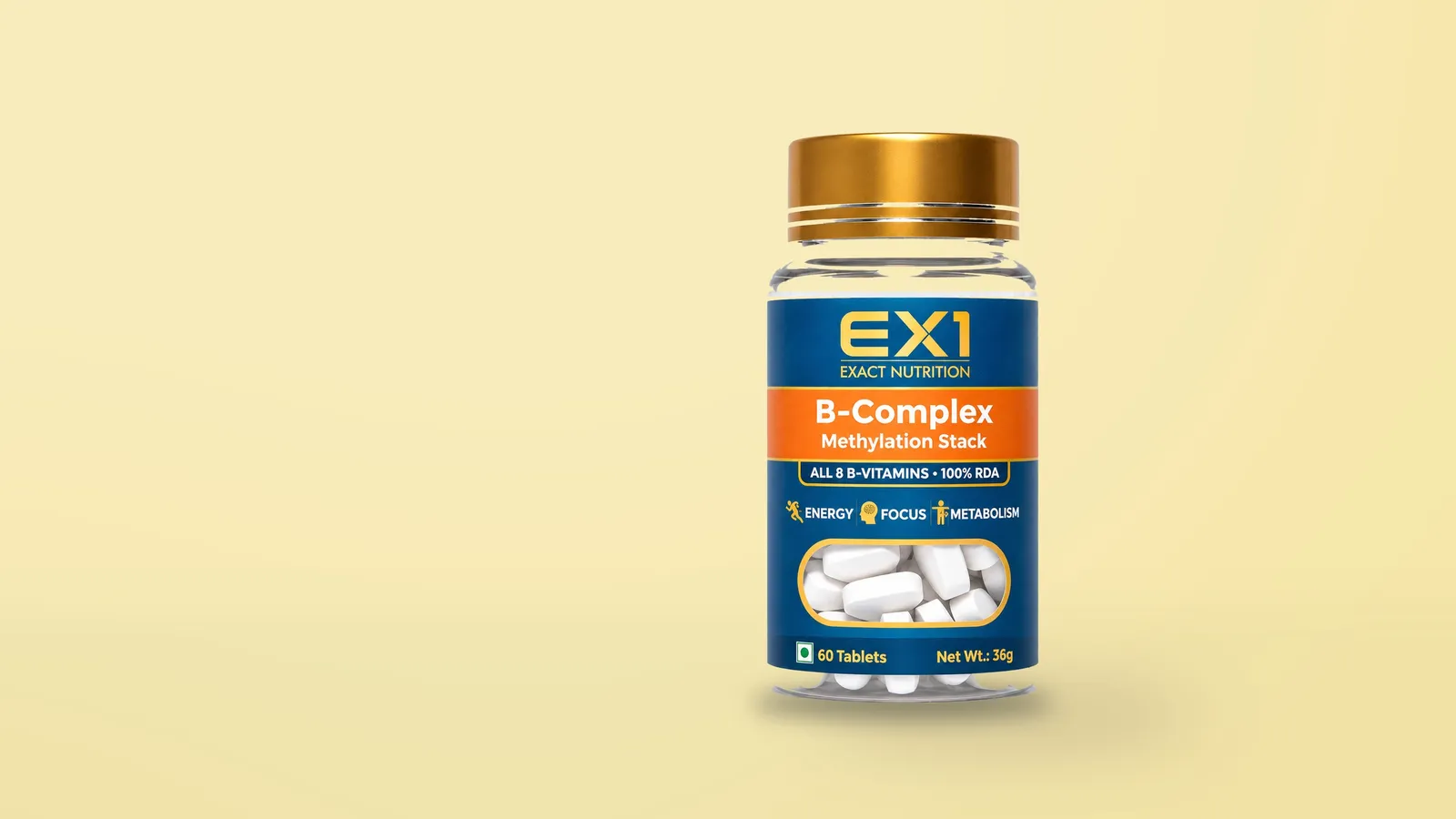
EX1 B-Complex is one tablet a day carrying all eight B vitamins, each at 100% of the RDA declared on the label: thiamine 1.8 mg, riboflavin (as riboflavin-5-phosphate) 2.5 mg, niacin (as niacinamide) 18 mg, pantothenic acid 5 mg, B6 (as pyridoxal-5-phosphate) 2.4 mg, biotin 40 mcg, folic acid 176.47 mcg and B12 (as cyanocobalamin) 2.2 mcg.
The thiamine, riboflavin, niacin, B6 and B12 amounts match ICMR-NIN's 2020 RDA for adult men.
It adds choline 82.5 mg, myo-inositol 50 mg and betaine 50 mg as methylation co-factors. Choline contributes to normal homocysteine metabolism and normal lipid metabolism, and EU rules allow that wording from 82.5 mg per portion, the amount in one tablet.
The claim of record is the authorised nutrient wording: B vitamins contribute to normal energy-yielding metabolism and the reduction of tiredness and fatigue. We print every amount on the pack. For how a combined total can hide each dose, read what a proprietary blend is. If you are also weighing iron, read our guide to iron tablets for women. If you are also weighing vitamin D, read our guide to vitamin D3 and K2.
Frequently asked questions
B-complex tablet ke fayde kya hain?
B-complex tablet ek hi tablet mein saare 8 B vitamins deti hai. Under the EU's authorised claims, B vitamins contribute to normal energy-yielding metabolism and the reduction of tiredness and fatigue. Biotin helps maintain normal hair and skin, and B12 contributes to normal nervous-system function. Think of it as daily cover for your diet. Do not expect a quick energy hit.
Can I take B-complex and a separate B12 tablet together?
Ask your doctor first. A high-dose B12 tablet is usually a correction dose, used when a blood test shows low B12, while a 100% RDA B-complex covers the daily requirement. The US Institute of Medicine set no upper limit for B12 because of its low potential for toxicity. If a doctor prescribed the B12, tell them you also take a B-complex.
Should I stop biotin before a blood test?
Tell your doctor or lab about every supplement you take, and ask whether to pause it. The US FDA warning about falsely high or low lab results concerns supplements carrying up to 100 mg of biotin. A 100% RDA tablet carries 40 mcg.
What are common signs of low vitamin B12?
Tiredness, weakness, and numbness or tingling can be signs of low B12, but they have many causes. A blood test is the only way to know, and a 100% RDA tablet is not meant to correct a deficiency. If you notice these signs, especially as a vegetarian, ask a doctor whether a B12 test makes sense (NIH Office of Dietary Supplements).
What are the symptoms of vitamin B12 deficiency?
Tiredness, weakness, and numbness or tingling are the signs most often linked to low B12, but each has many causes, so symptoms alone cannot tell you. A blood test can, and a doctor decides what to do with the result (NIH Office of Dietary Supplements). A 100% RDA tablet is not meant to correct a deficiency.
Which vegetarian foods contain vitamin B12?
B12 is found naturally in animal foods, including eggs, milk and milk products such as curd and paneer, according to the NIH Office of Dietary Supplements. Plant foods do not carry it unless fortified.
B-complex khane ke baad lena chahiye ya pehle?
Khane ke saath ya baad mein. EX1 suggests the morning, with or after food. No trial shows that timing changes how B vitamins work at a daily-RDA dose. Pick one time, say breakfast, and keep it.
Sources
- European Commission Regulation 432/2012 (list of authorised nutrient claims): riboflavin, niacin, pantothenic acid, biotin, thiamine, B6 and B12 contribute to normal energy-yielding metabolism; riboflavin, niacin, pantothenic acid, folate, B6 and B12 to the reduction of tiredness and fatigue; plus the riboflavin, biotin, B6, B12 and choline wording used above, and the 82.5 mg choline condition.
- EFSA Journal, 2009: scientific opinion on vitamin B12 and normal red blood cell formation and energy-yielding metabolism.
- EFSA Journal, 2023: tolerable upper intake level for vitamin B6 set at 12 mg a day for adults.
- ICMR-NIN, Nutrient Requirements for Indians, 2020: adult RDAs for thiamine, riboflavin, niacin, B6, folate and B12.
- Journal of the Association of Physicians of India, 2006: 441 men in and around Pune; 67% had low B12, 81% of urban middle-class men; vegetarians at 4.4 times the risk.
- Nutrition Reviews, 2013: review of 18 studies finding B12 depletion among vegetarians across ages and diet types.
- Asia Pacific Journal of Clinical Nutrition, 2010: 80% of rural and about two-thirds of urban pregnant women in Pune had low B12 at enrolment.
- Human Nutrition, open university textbook, 2022: excess riboflavin is excreted in urine and is harmless; no upper limit set.
- Journal of the American Dental Association, 2012: 160 adults, multivitamin at 100% of US reference intakes for up to a year; no reduction in the number or length of mouth-ulcer episodes.
- Journal of the American Board of Family Medicine, 2009: 1000 mcg B12 nightly; more participants free of sores by month six; partly industry-funded.
- Skin Appendage Disorders, 2017, and Journal of Drugs in Dermatology, 2017: biotin helped hair or nails only with an underlying deficiency or condition; limited evidence in healthy people.
- NIH Office of Dietary Supplements, Vitamin B12 fact sheet (2020): intrinsic factor limits absorption; about 10 mcg of a 500 mcg tablet absorbed; about 1% absorbed passively; no upper limit set; food sources; signs of low B12; medicines that lower B12.
- US FDA safety communication, 2017, updated 2019: biotin can cause falsely high or falsely low lab results; some supplements carry up to 100 mg.