Vitamin D3 and K2: Why They Are Taken Together
By Ayush Goyal, Founder, EX1
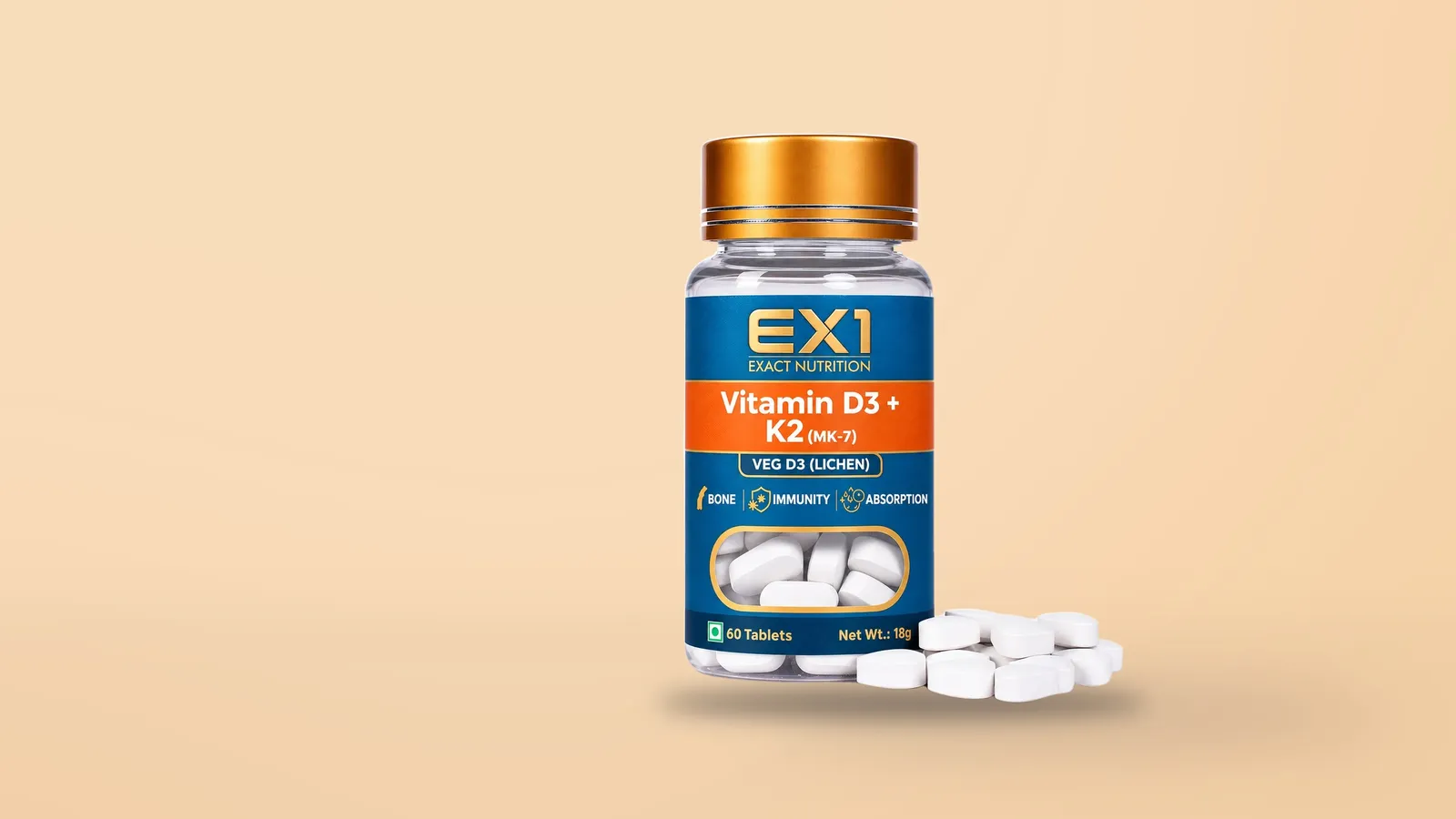
Vitamin D3 and K2 are paired for convenience: both are fat-soluble and both play a part in bone health. Here is what each one does, how much adults need, and why we found no trial of the two together.
Vitamin D3 and K2 are taken together because both are fat-soluble and both play a part in bone health, so one tablet with a meal covers both. We found no trial that tested vitamin D3 K2 as a pair at everyday doses, so the honest case rests on what each nutrient does on its own.
Vitamin D helps your gut absorb calcium. Vitamin K contributes to the maintenance of normal bones. And low vitamin D is common in India, sunshine and all.
Why are vitamin D3 and K2 taken together?
Vitamin D3 and K2 are taken together for convenience, because both are fat-soluble and both play a part in bone health. One tablet with a meal covers both. No trial has tested this exact pairing at daily-tablet doses, so any claim that the two work better together goes beyond the evidence.
A D3 and K2 tablet is two nutrients with two separate jobs in one daily habit. Vitamin D handles calcium absorption and contributes to normal muscle and immune function. Vitamin K contributes to the maintenance of normal bones.
The pairing is often sold as if one is incomplete without the other, but we found no trial of the combination. Our read: a sensible convenience, nothing more.
What does vitamin D3 do in the body?
Vitamin D3 helps the gut absorb calcium from food. It also contributes to normal immune function and normal muscle function, according to a 2010 scientific opinion in the EFSA Journal. In a 2013 trial in the American Journal of Clinical Nutrition, about 2,500 IU a day for six weeks raised calcium absorption compared with placebo.
Vitamin D3 (cholecalciferol) is the form of vitamin D your skin makes in sunlight. Its best-known job is moving calcium from your plate into your body.
The 2013 trial used about 2,500 IU a day, more than four times the adult RDA. It shows the mechanism. It does not tell you what a smaller daily dose would do.
What does vitamin K2 (MK-7) do?
Vitamin K2 (MK-7) is needed to activate osteocalcin, a bone protein. Vitamin K, including K2, contributes to the maintenance of normal bones (EFSA Journal, 2009). In trials, clear effects on osteocalcin appeared at about 90 to 200 mcg of MK-7 a day, more than a 55 mcg label reference amount.
Vitamin K2 is a family of compounds called menaquinones, and MK-7 is one of them. MK-7 stays in the blood far longer than vitamin K1 (Blood, 2007).
Two trials measured this, one in the Journal of Nutritional Science and Vitaminology (2015) and one in the British Journal of Nutrition (2012). In both, the clear effects showed at about 90 to 200 mcg of MK-7 a day. Both were run or funded by MK-7 producers. Weigh them with that in mind.
The longest trial we found ran for three years. In a 2013 three-year trial of 244 postmenopausal women, 180 mcg of MK-7 a day slowed the age-related decline in bone density at the lower spine and the femoral neck (the top of the thigh bone). It did not do so across the total hip.
How common is low vitamin D in India?
Low vitamin D is widely reported in India. A 2014 review in Nutrients reported low vitamin D in 70 to 100 percent of the general Indian population across the studies it covered, partly because daily routines limit sun exposure. In a 2011 study of 1,346 healthy Delhi adults aged 50 and over, 91.2% were below 20 ng/mL.
Vitamin D status is measured as 25(OH)D in a blood test, and the studies below use under 20 ng/mL as the cut-off for low. A day spent cab to desk to cab gives your skin little direct sun. Covered clothing cuts it further.
In more than 11,000 vitamin D tests at one Jodhpur hospital laboratory (2018 to 2020), 60% were below 20 ng/mL. Levels were lower in winter than in summer. These were people sent for testing, not a random sample (Metabolism Open, 2024).
The Delhi study (Journal of the Association of Physicians of India) covered one city and one age band. None of the three is a national rate. Together, they are hard to shrug off.
Two nutrients, two jobs, one tablet
Vitamin D3
- 600 IU a day: the adult RDA.ICMR-NIN, 2020
- Contributes to normal immune function and normal muscle function.EFSA Journal, 2010
- Peak blood D3 was 32% higher with a fat-containing meal, in one single-dose trial of 50 older adults.Journal of the Academy of Nutrition and Dietetics, 2015
Vitamin K2 (MK-7)
- 55 mcg MK-7: 100% of the label reference.EX1 label
- Contributes to the maintenance of normal bones.EFSA Journal, 2009
- Osteocalcin effects in trials appeared at about 90 to 200 mcg a day, above 55 mcg.Journal of Nutritional Science and Vitaminology, 2015; British Journal of Nutrition, 2012
One Jodhpur hospital lab, more than 11,000 tests, 2018 to 2020: 60% below 20 ng/mL. Metabolism Open, 2024
On a blood thinner? 50 mcg or more of MK-7 a day may interfere. Ask your doctor first. Blood, 2007
Vitamin D deficiency symptoms: which signs are worth a blood test?
Vitamin D deficiency symptoms in adults typically show up as muscle and bone aches and weakness, according to a 2010 clinical review in the BMJ. Those signs have many possible causes, so take them as a reason to ask your doctor for a 25(OH)D blood test. The test is the only way to know your level.
Signs of low vitamin D are a prompt to test, not a verdict. Aches and weakness can come from low vitamin D, or from poor sleep, a hard week or plenty else.
If the aches have stayed with you, or you rarely get direct sun, ask for the test. If you are over 50 in a north Indian city, the Delhi figures are a reason to ask sooner.
Ask for a "25(OH)D" or "25-hydroxy vitamin D" test. Your doctor reads the number and sets the dose; the symptom does not.
How much vitamin D3 and K2 do adults need each day?
Adults in India need 600 IU of vitamin D a day, according to ICMR-NIN (2020), for men and women alike. The US Institute of Medicine set the same 600 IU for ages 1 to 70, meant to cover at least 97.5% of people. For vitamin K2, 55 mcg is a label reference amount, below K2 bone-trial doses.
The RDA is the daily amount meant to cover nearly everyone's need, not a correction dose. The Institute of Medicine figure, summarised in the Journal of Clinical Endocrinology and Metabolism in 2011, matches a blood level of at least 20 ng/mL. Higher blood levels were not consistently linked with greater benefit.
As of October 2026, 600 IU remains the ICMR-NIN adult figure. Already on a multivitamin or a calcium tablet? Add up the IU on every label.
Is a 60,000 IU vitamin D3 sachet the same as a daily tablet?
A 60,000 IU vitamin D3 sachet is 100 times a 600 IU daily tablet. One sachet a week averages about 8,570 IU a day (our arithmetic). These sachets are a correction dose a doctor prescribes for a set period after a blood test. A daily 600 IU tablet is a maintenance amount.
Weekly 60,000 IU sachets and daily RDA tablets do different jobs. Take weekly sachets and "vitamin D3 K2 60,000 IU" products only on a doctor's advice. If you are already on one, ask before adding any daily vitamin D.
In a 2010 Indian trial in Clinical Endocrinology, 60,000 IU a week for eight weeks, given with daily calcium under study supervision, raised blood vitamin D from about 10 to about 38 ng/mL, and monthly doses afterwards did not hold it in the sufficient range.
Very high doses belong with a doctor. In a 2019 Kashmir study (Indian Journal of Endocrinology and Metabolism), every patient with vitamin D toxicity had received repeated vitamin D injections, a median of 4.2 million IU in total.
| Daily tablet | Weekly sachet | |
|---|---|---|
| Amount per dose | 600 IU | 60,000 IU |
| Average per day | 600 IU | About 8,570 IU (our arithmetic) |
| Job | Maintenance, at the adult RDA | Correction, for a set period |
| Who decides | The label | Your doctor, after a blood test |
D3 or D2, MK-7 or MK-4: does the form matter?
Vitamin D3 raised blood vitamin D more than D2 overall in a 2012 meta-analysis in the American Journal of Clinical Nutrition, but the clear advantage showed with large, infrequent doses and was lost with daily dosing. For K2, MK-7 stays in the blood far longer than vitamin K1 (Blood, 2007).
Form is the exact molecule on the label: D3 (cholecalciferol) or D2 (ergocalciferol) for vitamin D, and K1, or K2 as MK-4 or MK-7, for vitamin K.
| Choice | What the research found | Source |
|---|---|---|
| D3 vs D2 | D3 raised blood vitamin D more than D2 overall. The clear advantage showed with large, infrequent doses and was lost with daily dosing. | American Journal of Clinical Nutrition, 2012 (meta-analysis) |
| MK-7 vs K1 | MK-7 stays in the blood far longer, giving steadier levels and a 7 to 8 times higher build-up with daily intake. | Blood, 2007 |
| MK-7 vs MK-4 | A daily 60 mcg of MK-7 raised blood MK-7 levels within a week. The same amount of MK-4 did not. | Nutrition Journal, 2012 (10 Japanese women) |
Read the last row narrowly: a small study of 10 women that measured blood levels, not bone. At a daily dose the D3 edge over D2 was not clear either. Check the form, then expect nothing extra from it.
When should you take vitamin D3 K2?
Take vitamin D3 K2 with a meal that contains some fat. In a 2015 single-dose trial of 50 older adults in the Journal of the Academy of Nutrition and Dietetics, peak blood vitamin D3 was 32% higher when the dose was taken with a fat-containing meal. The meal matters more than the clock.
Both vitamins dissolve in fat, and the fat in your meal helps carry them in. Dal with a spoon of ghee, a paratha or eggs will do. A black coffee on an empty stomach will not.
The trial used one large 50,000 IU dose, so the 32% belongs to that trial; only the direction carries over. Take it with the meal you never skip.
Who should not take vitamin K2?
Vitamin K2 is not for people on warfarin or another blood thinner that works against vitamin K, unless their doctor agrees. Researchers writing in Blood (2007) cautioned that supplements supplying 50 mcg or more of MK-7 a day may interfere with these medicines. Pregnant and breastfeeding women should ask a doctor first.
Some blood thinners are designed to work against vitamin K, so extra K2 can matter. If you take warfarin or another blood thinner that works against vitamin K, do not start a vitamin K2 supplement without your doctor. Researchers writing in Blood (2007) cautioned that supplements supplying 50 mcg or more of MK-7 a day may interfere with these medicines, and the EX1 D3 + K2 tablet contains 55 mcg. Multivitamins and calcium tablets can carry K2 too.
Consult a physician before use if pregnant, lactating, on medication or with a medical condition. Not to be used by children.
How EX1 fits
EX1 Vitamin D3 + K2 gives 600 IU of vitamin D3 from lichen and 55 mcg of vitamin K2 as MK-7 (all-trans) in one tablet a day.
According to ICMR-NIN (2020), adults need 600 IU of vitamin D a day, and EX1's tablet contains 600 IU. The 55 mcg of K2 is a daily-adequacy amount, lower than the 90 to 200 mcg in the osteocalcin trials. The three-year trial used 180 mcg, more than three times this amount. These are label facts. They promise no study's result.
The D3 comes from lichen, so it is suitable for vegetarians. The claims EX1 makes rest on the two nutrients: vitamin D contributes to normal bones, normal muscle function and normal immune function, and vitamin K2 contributes to the maintenance of normal bones.
Take one tablet a day with or after food, ideally a meal with some fat. Do not exceed the recommended daily usage. For why an RDA-level dose is a maintenance amount, see why most multivitamins underperform.
Related reading: magnesium glycinate benefits, B-complex tablet uses and vitamin C tablets benefits.
Frequently asked questions
Vitamin D3 K2 kab lena chahiye, subah ya raat?
Us meal ke saath lijiye jismein thoda fat ho, jaise dal-ghee, paratha ya ande. A 2015 single-dose trial found peak blood vitamin D3 was 32% higher with a fat-containing meal. Subah ya raat se zyada meal matter karta hai, isliye roz ek hi meal ke saath lijiye.
Can I take vitamin D at night?
Yes, if night is when you eat a meal with some fat. The 2015 absorption trial looked at the meal, not the time of day, and found peak blood vitamin D3 32% higher with a fat-containing meal. If dinner is your proper meal of the day, dinner it is.
Can I take vitamin D3 K2 with magnesium?
Our sources did not study vitamin D3 K2 with magnesium, so we make no claim either way. Watch the vitamin D. Some magnesium tablets also contain D3, so add up the IU across every label. Our guide to magnesium elemental dose vs salt weight explains how to read a magnesium label.
Is vitamin D3 K2 good for men?
Vitamin D3 K2 does the same job in men and women, and ICMR-NIN (2020) sets the same 600 IU adult RDA for both. Vitamin D contributes to normal bones, muscle function and immune function, and vitamin K2 to the maintenance of normal bones. The evidence we reviewed shows no separate men's benefit.
Does a daily 600 IU tablet correct low vitamin D?
A daily 600 IU tablet is a maintenance amount, the adult RDA set by ICMR-NIN (2020). Correcting a low blood level is your doctor's call: they prescribe a higher dose, such as a weekly 60,000 IU sachet, for a set period after a blood test.
Is lichen vitamin D3 vegetarian?
Yes. Vitamin D3 from lichen is plant-sourced, so it is suitable for vegetarians, and it is the same molecule, cholecalciferol. D3 can also be made from lanolin, which comes from sheep's wool, so check the source named on the label.
Sources
- ICMR-NIN, 2020 (Nutrient Requirements for Indians): adult vitamin D RDA of 600 IU a day for men and women.
- Journal of Clinical Endocrinology and Metabolism, 2011: summary of the US Institute of Medicine report; 600 IU a day for ages 1 to 70, covering at least 97.5% of people, matching a blood level of at least 20 ng/mL; higher levels not consistently linked with greater benefit.
- Nutrients, 2014 (review): low vitamin D reported in 70 to 100 percent of the general Indian population across the studies covered; limited sun exposure part of the reason.
- Metabolism Open, 2024: more than 11,000 vitamin D tests at one Jodhpur hospital laboratory, 2018 to 2020; 60% below 20 ng/mL; lower in winter than summer.
- Journal of the Association of Physicians of India, 2011: 1,346 healthy Delhi adults aged 50 and over; 91.2% below 20 ng/mL.
- BMJ, 2010 (clinical review): in adults, low vitamin D typically presents as musculoskeletal pain and weakness.
- American Journal of Clinical Nutrition, 2013: randomised trial; about 2,500 IU vitamin D3 a day for six weeks raised calcium absorption compared with placebo.
- EFSA Journal, 2010: vitamin D contributes to normal immune function and normal muscle function.
- EFSA Journal, 2009: vitamin K, including K2 (menaquinones), contributes to the maintenance of normal bone.
- Journal of Nutritional Science and Vitaminology, 2015: MK-7 raised activated osteocalcin dose-dependently, with clear effects at 100 and 200 mcg a day; authors from an MK-7 producer.
- British Journal of Nutrition, 2012: MK-7 at doses around 90 mcg a day and above raised activated osteocalcin; funded by an MK-7 producer.
- A 2013 three-year randomised trial: 244 healthy postmenopausal women; 180 mcg MK-7 a day slowed the age-related decline in bone density at the lower spine and femoral neck, not the total hip.
- Blood, 2007: MK-7 has a much longer half-life than vitamin K1, with 7 to 8 times higher build-up on daily intake; researchers cautioned that 50 mcg or more of MK-7 a day may interfere with oral anticoagulants.
- Nutrition Journal, 2012: small study of 10 Japanese women; 60 mcg MK-7 a day raised blood MK-7 within a week, while MK-4 did not.
- American Journal of Clinical Nutrition, 2012 (meta-analysis): D3 raised blood vitamin D more than D2 overall; the advantage was clear with bolus doses and lost with daily dosing.
- Journal of the Academy of Nutrition and Dietetics, 2015: single-dose trial in 50 older adults; peak blood D3 32% higher with a fat-containing meal.
- Indian Journal of Endocrinology and Metabolism, 2019: Kashmir study; every patient with vitamin D toxicity had received repeated vitamin D injections, median total 4.2 million IU.
- Clinical Endocrinology, 2010: 40 young healthy Indian adults with low vitamin D; 60,000 IU a week for 8 weeks then monthly for 4 months, with daily calcium, against placebo; blood vitamin D rose, then fell back below the sufficient range on the monthly doses.